
To choose the right size for a tv console wall mount, you must balance the physical dimensions of your television, the structural capacity of your wall, and the layout of your living space. A well-proportioned floating console does more than just hold your media devices; it acts as a visual anchor that grounds your entire living room design. Generally, a wall-mounted console should be at least 10% to 30% wider than your TV, mounted at a height that keeps the screen’s center at eye level, and have a depth that preserves comfortable walkway clearance. In compact urban environments, getting these measurements right is essential to avoid a cramped, cluttered, or structurally unsafe setup.
Measure Your Wall Space and TV Dimensions Before Shopping
Before browsing online marketplaces or visiting local showrooms, you must establish the physical boundaries of your room. Start by measuring the total width and height of the designated wall space. Do not assume the wall is a blank canvas; note existing architectural features like adjacent doors, windows, built-in shoe cabinets, or structural pillars that could limit the console’s physical footprint. Additionally, map out the exact positions of your electrical outlets, fiber termination points, and antenna ports. A wall-mounted console needs to sit over or directly adjacent to these outlets to keep wiring concealed, so knowing their coordinates will help you choose a unit with matching cable management cutouts.
Next, measure your television’s actual physical dimensions rather than relying on its advertised screen size. Television sizes, such as 55 inches or 65 inches, represent the diagonal measurement of the screen glass alone, excluding the outer bezel or frame. Use a physical tape measure to record the exact outer width, height, and depth of your TV frame. This physical width is the most critical number when determining the appropriate width of your floating console.
Products mentioned in this guide
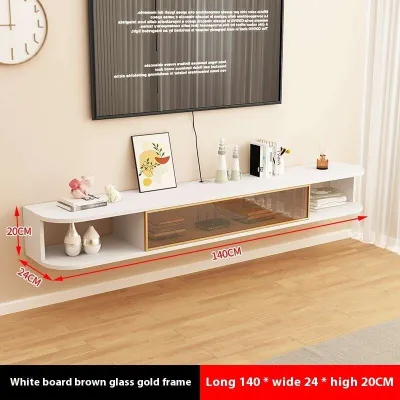
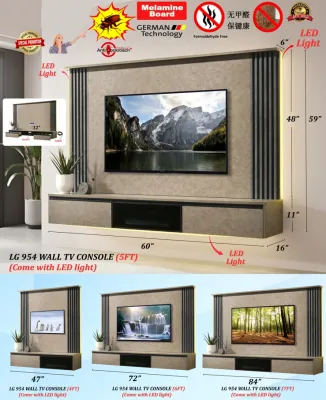
![[Ready Stock] TV console nordic wall-mounted TV cabinet wall cabinet wall racks set-top rack set-top cabinet TV cabinets simple small-sized TV rack wall TV console wall TV cabinet](https://img.lazcdn.com/g/p/cfdf1ff4d0a9e38b9b7833f1ef9be69d.jpg_webp_400x400q80.jpg_.webp)
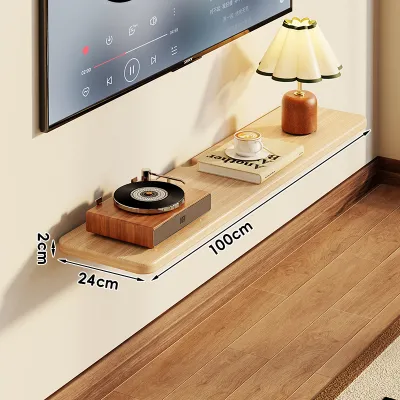
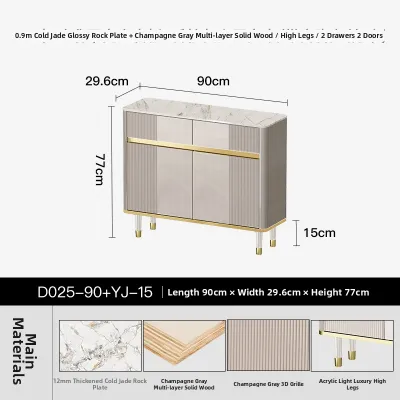
Prices are valid at publication and may change. Please refer to the product page for the latest price.
You also need to factor in necessary clearances for ventilation, cable routing, and any peripheral devices you plan to place on or inside the console. If you plan to display decorative items, family photos, or a soundbar on the console’s top surface, measure these items beforehand to ensure they will fit comfortably without spilling over the edges.
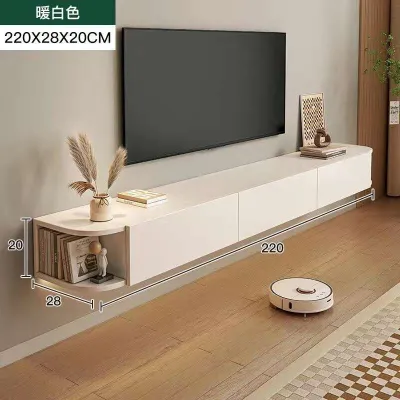
Finally, measure the walkway clearance in front of the proposed console location. In compact apartments, such as modern HDB flats or condominiums, every centimeter of floor space matters. A standard high-traffic walkway should ideally maintain a clear path of 60 cm to 90 cm. Measure the distance from the wall to your coffee table or sofa to determine the maximum allowable depth of your floating console. Choosing a shallow console with a depth of 25 cm to 30 cm can preserve precious floor space.
Match the Console Width to Your TV for Visual Balance
Achieving visual balance is the key to a professional-looking living room design. An essential interior design guideline is that your wall-mounted TV console should always be wider than the television itself. When a console is the same width or narrower than the TV, it creates an awkward, top-heavy silhouette that makes the room feel unstable and visually cluttered. A wider console acts as a visual base, grounding the television and creating a balanced, harmonious composition.

To apply this design principle, aim for a console that is approximately 1.2 to 1.6 times the width of your television. For example, a standard 55-inch television (approx. 122 cm wide) pairs beautifully with a console that is at least 150 cm to 180 cm wide, while a 65-inch television (approx. 145 cm wide) is best matched with a console measuring 180 cm to 210 cm. This extra width on either side of the TV provides a sense of breathing room and offers a dedicated space to place small decorative items or a soundbar.
In space-constrained environments, you can adapt these rules. If your wall space only permits a console that matches the exact width of your TV, opt for an asymmetrical layout by mounting the TV slightly off-center and balancing the opposite side with a tall vase or books. Alternatively, choosing a floating console with clean, handle-less doors in a color that matches your wall can make the unit blend into the background, reducing its visual weight.
The depth of your console also plays a major role in its visual footprint. A standard floating console typically ranges from 30 cm to 45 cm in depth. If you plan to place the TV directly on the console surface, you must ensure the console is deep enough to accommodate the television’s base stand or legs safely. If your TV is wall-mounted independently above the console, you can select a much shallower floating unit—around 25 cm to 30 cm deep—as it only needs to house slim media players or routers.
Calculate the Ideal Mounting Height for Comfortable Viewing
Determining the correct vertical placement for your floating console is critical for both viewing ergonomics and overall room aesthetics. The primary goal of ergonomic TV positioning is to ensure that the center of the television screen aligns directly with your eye level when you are seated comfortably on your sofa.
To calculate the perfect mounting height, start by measuring the seated eye level of the primary viewers in your household. Sit on your sofa in your natural viewing posture and measure the distance from the floor to your eyes—typically between 100 cm and 110 cm for most standard setups. This represents the target height for the center of your screen.
Once you have established your eye-level height, you can determine the placement of your floating console based on how your TV will be supported. If the TV rests on the console, subtract half of your television’s physical height (including its stand) from your seated eye-level measurement. The resulting number is the target height for the top surface of your floating console. For example, if your eye level is 105 cm and half of your TV’s height is 35 cm, the top of your console should be mounted exactly 70 cm from the floor.
If the TV is wall-mounted above the console, first mount your television on the wall so that its center aligns with your 100 cm to 110 cm eye level. Once the TV is securely positioned, you can determine the height of your floating console. When both the TV and the console are wall-mounted, you must leave adequate visual breathing room between the bottom of the television and the top surface of the console. A gap of 10 cm to 20 cm is highly recommended. This physical separation prevents the setup from looking cramped, ensures that remote control infrared signals can reach your devices without obstruction, and provides dedicated space for a soundbar.
Verify Weight Capacity and Wall Compatibility for Safe Installation
A floating TV console relies entirely on its wall mounting system. Verifying the structural integrity of your wall and the weight capacity of the console is a critical safety step to prevent structural failure, property damage, or personal injury.
Begin by calculating the total expected load that the console will need to support. This calculation must include the dry weight of the console itself (often 15 kg to 40 kg depending on whether it is made of MDF or solid timber), the weight of your television (typically 15 kg to 30 kg for modern mid-to-large screens), and the cumulative weight of all media devices, gaming consoles, soundbars, and decorative objects.
Next, identify your wall type. Solid concrete or brick walls are extremely common in Singapore HDB flats and structural walls of private condominiums. These walls offer exceptional load-bearing strength. When installing a floating console on concrete, you must use high-quality masonry wall plugs or sleeve anchors paired with heavy-duty lag screws. This combination ensures a permanent, rock-solid hold that can easily support heavy solid wood consoles.
Drywall or partition walls are frequently used for non-structural interior walls or room dividers. Standard drywall sheets cannot support the weight of a floating console on their own. For safe installation, you must locate the internal timber or metal studs behind the drywall using a stud finder. The console’s mounting bracket must be screwed directly into these structural studs. If the stud spacing does not align with your console’s mounting holes, or if you must mount between studs, you must use specialized heavy-duty toggle bolts, though a professional consultation is highly recommended.
Always consult the manufacturer’s product manual to verify the maximum weight limit specified for the floating console. Never exceed this rated capacity, even if you believe your wall is strong enough. If you are unsure of your wall’s composition, or if the total weight of your setup exceeds standard DIY capabilities, hire a qualified professional installer or consult your building’s management office.
Common Sizing and Placement Mistakes to Avoid
Avoiding common pitfalls during the selection and installation process can save you from costly mistakes, safety hazards, and aesthetic frustration. One of the most frequent errors is choosing a floating console that is too deep for the room. In narrow living spaces, a deep console protrudes too far into the room, creating a physical tripping hazard and disrupting the flow of traffic.
Another common oversight is ignoring cable management planning. A beautiful floating console can be completely ruined by a messy tangle of black wires hanging visibly beneath the unit. Before purchasing a console, check if it features built-in cable routing holes, wire management channels, or a recessed back panel. If your TV is wall-mounted, plan how you will route cables between the TV and the console—either through an in-wall conduit installed during renovation or via a color-matched external cable trunking system.
Many homeowners also make the mistake of mounting their console at an arbitrary height without first testing the viewing angles from their primary seating area. Take the time to map out the proposed positions of both the TV and the console on the wall using painter’s tape. Sit on your sofa and look at the taped outlines to verify that the setup feels comfortable and looks visually balanced before drilling any holes.
Finally, never compromise on structural safety by overloading the console or using inappropriate wall anchors. Standard plastic wall plugs included in generic hardware packs are often insufficient for the heavy shear loads of a floating console. Invest in high-quality, heavy-duty anchors designed specifically for your wall type, and strictly adhere to the manufacturer’s weight limits to prevent the unit from pulling away from the wall over time.
Frequently Asked Questions (FAQ)
Can I mount a floating TV console on a drywall partition?
Standard drywall or partition walls are not designed to support the heavy, cantilevered weight of a loaded floating TV console on their own. To install a floating console safely on a partition wall, you must locate the internal wooden or metal studs behind the plasterboard using a reliable stud finder and anchor the mounting brackets directly into these structural supports. If the studs do not align with your desired placement, or if the wall lacks internal timber reinforcement, you may need to use heavy-duty steel toggle bolts or have a professional installer reinforce the wall internally. Always consult a qualified professional to assess your wall’s load-bearing capacity before proceeding with the installation.
How much space should I leave between the TV and the wall-mounted console?
For an optimal balance of aesthetics and functionality, you should leave a visual gap of 10 cm to 20 cm between the bottom of your wall-mounted TV and the top surface of your floating console. This physical clearance prevents the wall from looking overcrowded and ensures that your electronic devices have adequate ventilation to dissipate heat. Additionally, this gap provides the perfect placement zone for a soundbar or small decorative items without blocking the bottom of your television screen or obstructing the TV’s infrared remote control receiver.
Community discussion
Share your experience or ask a question. Comments are reviewed before publication.