
Choosing a rotatable bookshelf is an excellent way to maximize book storage in a compact footprint, but selecting the wrong size can lead to scraped walls, blocked walkways, or a unit that simply cannot spin. Unlike traditional static bookcases, a revolving unit requires a dynamic “clear zone” to function properly. Finding the perfect fit requires balancing your storage volume with both the static footprint of the base and the wider circular path of the shelf’s rotation.
To make an informed decision, you must evaluate your current book collection, calculate the exact swing radius required for rotation, and verify the physical constraints of your room. Taking these steps ensures your new furniture piece remains fully functional, safe, and visually proportional to your living space.
Assess Your Storage Needs to Determine Capacity
Before measuring your physical floor space, you must determine how much storage capacity your collection actually requires. A common mistake is buying a bookshelf based solely on how it looks, only to find it cannot hold your books or leaves massive amounts of wasted space. Start by taking an inventory of your current collection, noting the physical sizes of your books. Standard paperbacks are relatively lightweight and compact, whereas heavy hardcovers, art books, and academic textbooks require deeper shelves and higher vertical clearance.
Products mentioned in this guide
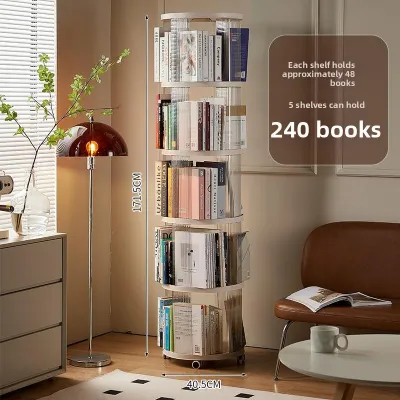
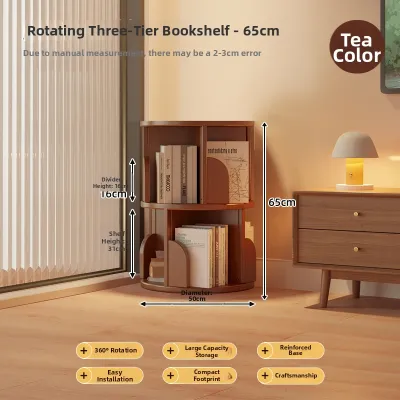
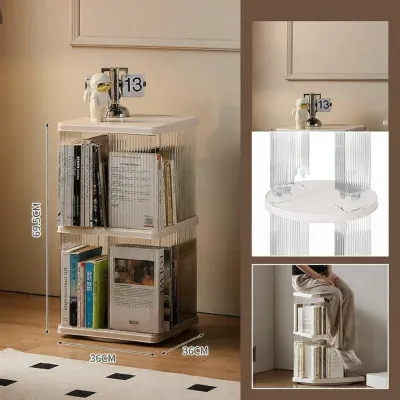
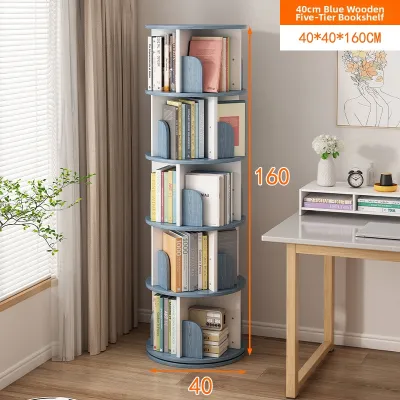
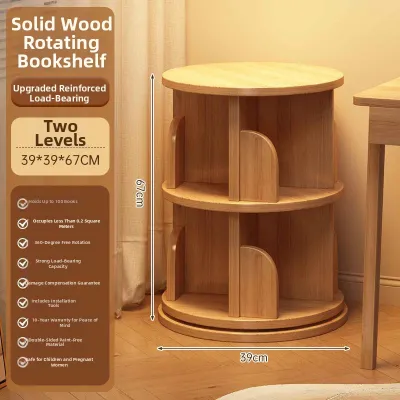
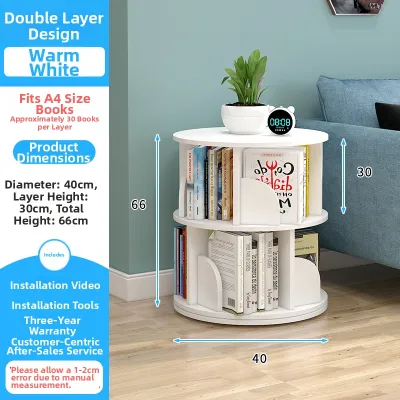
Prices are valid at publication and may change. Please refer to the product page for the latest price.
If you are an active reader, your collection is likely to grow over time. Selecting a bookshelf that only fits your current inventory will leave you with an overflow problem in a matter of months. A practical rule of thumb is to choose a unit that offers roughly 20% to 30% more storage capacity than you currently need. This built-in buffer allows your collection to expand naturally without requiring you to buy additional furniture or stack books in cluttered piles on the floor.
Many homeowners use rotatable bookshelves for mixed-use storage rather than books alone. If you plan to incorporate decorative items, small indoor plants, storage baskets, or office box files, you must account for their unique dimensions. These items are often wider or taller than a standard novel, meaning they will require deeper shelf tiers. Failing to plan for these non-book items can result in a cramped layout where your favorite decor pieces are forced into awkward angles or cannot fit at all.
To accommodate a diverse range of items, pay close attention to shelf height and adjustability. Fixed-tier bookshelves can be highly restrictive, forcing you to lay tall books horizontally, which wastes valuable vertical space. Opting for a rotatable unit with adjustable shelf heights gives you the flexibility to customize the spacing between tiers. If adjustable options are not available, carefully measure your tallest books and compare them against the manufacturer’s tier-height specifications before making a purchase.
Measure Floor Space and Rotation Clearance
The defining feature of a rotatable bookshelf is its ability to spin, which means its physical footprint changes dynamically. Measuring only the static base of the unit is a recipe for disappointment. A square base that sits flat on the floor might seem small, but as it rotates, its corners sweep out a much larger circular path. This maximum circular path is known as the rotation diameter or swing radius, and it is the most critical measurement you must consider when planning your room layout.

To find the actual space required for a square-shelved unit, you must calculate its diagonal measurement rather than its flat width. The diagonal of a square is always longer than its sides, and this diagonal represents the absolute minimum diameter of the circle the unit will describe as it spins. For a round rotatable bookshelf, the rotation diameter is generally the same as the static diameter of the shelves, making spatial planning slightly more straightforward but still requiring careful verification.
Once you have identified the rotation diameter of your desired bookshelf, use painter’s tape to mark this circle on your floor in the chosen location. This simple visual aid allows you to see exactly how much physical space the spinning unit will occupy. To ensure comfortable use, you must add a safety buffer of at least 5 to 10 centimeters around the entire perimeter of this circle. This buffer prevents your knuckles from getting pinched or scraped against the wall when you spin the shelf and ensures the unit does not rub against your paintwork.
In addition to wall clearance, you must check for potential conflicts with surrounding architectural features and furniture. Walk around your taped circle and look for low-hanging window sills, door swings, curtains, radiators, and electrical outlets. If a power outlet is located directly behind the bookshelf, the cords and plugs extending from the wall will reduce your available clearance. You must also ensure the spinning shelves do not block light switches or impede the natural flow of foot traffic through the room.
Do not forget to measure your vertical clearance, especially if you are opting for a tall four-tier or five-tier model. Measure the ceiling height in the exact spot where the bookshelf will stand, keeping in mind that some floors can be slightly uneven. If you plan to place decorative items, plants, or smart speakers on the very top surface of the bookshelf, you must leave enough vertical clearance below the ceiling or any overhead light fixtures to accommodate these items safely.
Match Bookshelf Dimensions to Your Layout
Choosing the right base shape is your first step in matching the bookshelf to your room’s layout. Round bases are exceptionally space-efficient and work beautifully in tight corners or open-plan areas, as their physical footprint matches their rotation path perfectly. Square bases, on the other hand, offer more usable shelf depth in the corners of each tier, making them highly practical for storing larger books. However, because they require a wider swing radius, they are best suited for rooms where you have a bit of extra floor space to spare.
Height and tier selection require a careful balance between storage capacity, stability, and visual proportion. While a tall five-tier bookshelf maximizes vertical space—which is highly beneficial in compact urban apartments—it can also make a small room feel cramped and dark. Furthermore, very tall units can be difficult for shorter family members or children to reach safely. Consider a lower two-tier or three-tier unit if you want to maintain an open, airy feel in your space or if the shelf is intended for a child’s bedroom.
Because a rotatable bookshelf relies on a central spinning mechanism, understanding weight capacity is vital for long-term durability. The entire weight of your book collection will rest on a central bearing or turntable assembly. You must verify the manufacturer’s weight specifications for both the individual tiers and the unit as a whole. Overloading the shelves can strain the rotation mechanism, causing it to grind, wobble, or seize up entirely. To maintain stability, always place your heaviest books on the bottom tiers to keep the center of gravity as low as possible.
Different room layouts naturally suit different size profiles, and mapping your space type to the right dimensions will simplify your search. For tight alcoves, narrow hallways, or small bedroom corners, a compact round unit with a diameter of 40 to 45 centimeters is usually ideal. If you are furnishing a spacious home office or an open living room, a larger square unit with a rotation diameter of 60 centimeters or more can serve as a stunning focal point or a functional room divider that remains accessible from multiple angles.
Common Sizing Mistakes and Safety Checks
One of the most frequent errors buyers make is measuring only the static base of the bookshelf and completely ignoring the swing radius. When the unit arrives and is fully loaded with books, they discover that it cannot rotate without scraping against the wall or colliding with nearby furniture. This mistake renders the rotatable feature useless, turning a specialized piece of furniture into an inconvenient static shelf. Always use the maximum diagonal rotation diameter as your primary guide during the planning phase.
Another critical safety hazard is top-heavy loading, which significantly increases the risk of the bookshelf tipping over. When heavy volumes are placed on the upper tiers, the unit’s center of gravity rises, making it highly unstable during rotation. To prevent accidents, always adhere to a strict bottom-heavy loading strategy. Place heavy textbooks, encyclopedias, and binders on the lowest shelf, and reserve the upper tiers for lightweight paperbacks, small novels, or light decorative items.
Before finalizing your purchase, you must also consider how the bookshelf will physically enter your home. Many buyers focus entirely on the room layout and forget to check delivery clearance. This is a particularly common issue in high-density apartments and condominiums, where furniture must navigate tight service lifts, narrow corridors, and standard door frames. Measure the dimensions of your entryways, apartment lift doors, and hallways, and compare them against the packaged box dimensions provided by the retailer to ensure a smooth delivery process.
Finally, perform essential safety and stability checks once the unit is assembled but before you load it with books. Place a spirit level on the floor where the bookshelf will stand; an uneven floor will cause the unit to lean, putting uneven lateral pressure on the rotation bearing. This can cause the mechanism to bind, squeak, or wear out prematurely. Additionally, test the empty unit to ensure the rotation is smooth and silent, and check that the base feels completely stable and does not wobble when spun.
Frequently Asked Questions (FAQ)
How much extra clearance do I need around a rotating bookshelf?
To find the correct clearance, take the maximum rotation diameter of the bookshelf (which is the diagonal measurement for square models) and add a safety buffer of at least 5 to 10 centimeters on all sides. This extra space prevents the corners of the shelves from scraping against your walls, baseboards, or adjacent furniture. It also ensures you have enough physical room to comfortably grip and spin the unit with your hands without trapping or scraping your fingers against nearby obstacles.
Is it safe to place a rotatable bookshelf on a thick carpet?
Placing a heavy, fully loaded rotatable bookshelf directly on a thick or plush carpet is generally not recommended. The soft, uneven surface can cause the base of the unit to sink, leading to an unlevel alignment that puts excessive lateral strain on the central rotation bearing. Over time, this can cause the spinning mechanism to squeak, bind, or break, while also increasing the risk of the unit tipping over. If you must place the bookshelf on a carpeted floor, check the manufacturer’s care instructions first, and consider placing a rigid, flat wooden or acrylic baseboard underneath the shelf to distribute the weight evenly and keep the rotation mechanism perfectly level.
Community discussion
Share your experience or ask a question. Comments are reviewed before publication.