
Organising your home with modular containers often brings a common frustration: buying a set of sleek boxes only to find they miss fitting into your wardrobe by a mere five millimetres, or that they leave awkward, dusty gaps at the back of your shelves. To choose the right Muji storage box size for your space, you must measure the exact internal clearance of your furniture, understand how the brand’s modular dimensions stack together, and account for physical obstructions like hinges and shelf pegs. Taking these steps before purchasing ensures a seamless, flush fit that maximises every cubic centimetre of your storage.
How do you accurately measure your shelves, drawers, and closet spaces?
To measure your storage spaces accurately, you must focus entirely on the internal usable dimensions rather than the external measurements of your furniture. External dimensions listed by furniture manufacturers often include decorative trim, thick outer panels, or backboards that significantly reduce the actual space available inside.
Begin by using a rigid steel tape measure rather than a flexible fabric tape, as fabric can sag and lead to inaccurate readings over longer spans. Measure the internal width from the left inner wall to the right inner wall, the internal depth from the back panel to the front edge of the shelf, and the internal height from the shelf surface to the underside of the shelf above.
Products mentioned in this guide
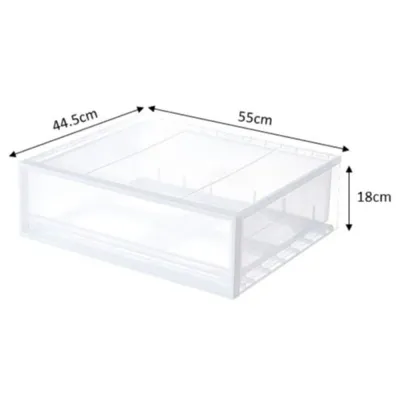
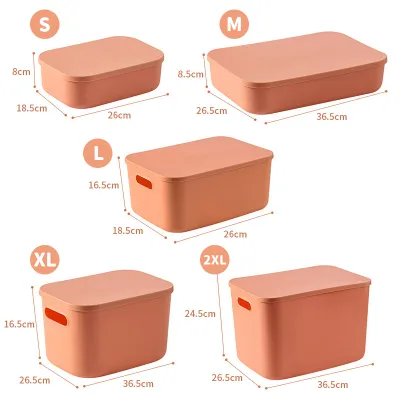
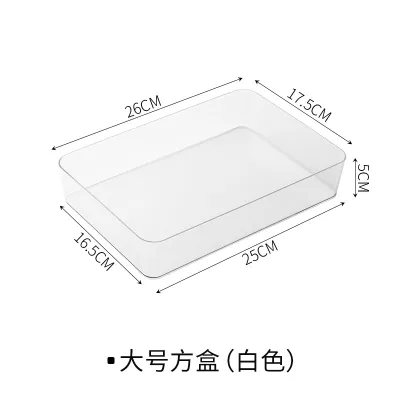
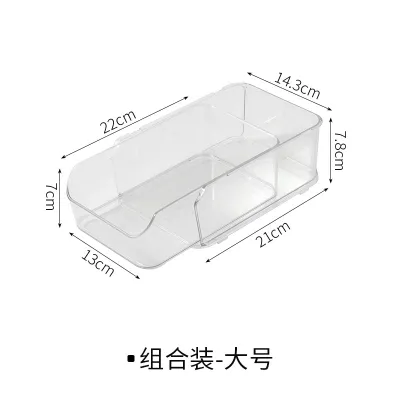
Prices are valid at publication and may change. Please refer to the product page for the latest price.
You must actively look for and subtract physical obstructions that project into the usable space. Cabinet door hinges, drawer slides, protruding cabinet lips, sliding door tracks, and adjustable shelf support pegs all reduce the actual clearance. For instance, a wardrobe might have an internal width of 80 centimetres, but a heavy door hinge might protrude 3 centimetres into that space, preventing a wide box from sliding past.
Always record the narrowest, shallowest, and shortest points within the compartment. If a shelf bows slightly in the middle or a wardrobe frame is not perfectly square, using the maximum measurement will result in boxes getting stuck. Measuring the absolute minimum clearance ensures your storage containers can slide in and out smoothly during daily use.
What are the standard dimensions and modular systems of Muji storage boxes?
Finding the exact dimensions of Muji storage boxes requires checking the official product labels, the brand’s website specifications, or in-store displays, as sizes vary across different material lines. Because the brand does not use a single universal sizing chart for all materials, verifying the precise external and internal dimensions of each specific model is essential before planning your layout.

The core of this storage system lies in its modular design, where widths and depths are engineered in standard increments to allow multiple boxes to sit side-by-side or stack neatly. For example, two half-width boxes are designed to sit perfectly atop a single full-width box of the same series, allowing you to build a stable, customized grid that fits standard shelving units.
However, you must differentiate between the various material types, such as polypropylene, soft polyethylene, polyester cotton linen, and natural rattan, as their structural designs affect usable space differently. Polypropylene boxes often feature straight, rigid walls with structural rims or lips at the top, which add to the external dimensions while maintaining a consistent internal capacity.
In contrast, soft polyethylene cases often have slightly tapered walls and rounded corners, meaning the bottom of the box is narrower than the top opening. Woven rattan baskets and fabric cases may have slight natural variances in size and flexibility, and their integrated handle cutouts or matching lids can alter the total height and depth required for a clean fit.
How do you match Muji box sizes to common furniture like built-in wardrobes or modular shelving?
Matching storage boxes to common furniture, such as built-in wardrobes or modular shelving units in Singapore homes, requires a systematic comparison of box depths and heights against your recorded measurements. A common mistake is selecting boxes based solely on width, leaving significant unused depth at the back of deep wardrobe shelves or causing boxes to overhang awkwardly.
Compare the external depth of the box against the usable depth of your shelf. For deep built-in wardrobes, which often measure 55 to 60 centimetres deep, using a single shallow box leaves wasted space behind it; in this scenario, placing two medium-depth boxes tandem-style or choosing extra-deep drawer cases maximizes the footprint. For shallow modular shelving units, ensure the box depth allows cabinet doors to close completely without pressing against the container fronts.
When planning to stack boxes, evaluate the vertical potential of your shelves by calculating the combined height of the stacked containers. You must verify that the total height of the stack is lower than the shelf clearance, leaving enough room at the top to comfortably lift the lid or slide the upper box out.
Additionally, you must verify the weight limits of your furniture shelves before loading them with multiple fully packed storage boxes. Heavy items stored in large polypropylene drawers can cause particleboard or MDF shelves to sag over time, potentially jamming the drawers below or compromising the stability of the entire shelving unit.
What clearance and handling factors should you consider before buying?
Before making your final purchase, you must account for the physical clearance and handling factors that dictate how easily you can access your stored items daily. A box that fits perfectly flush within a shelf with zero millimetres of clearance on either side will be incredibly difficult to pull out or slide back in.
Calculate a necessary finger clearance of at least one to two centimetres on the sides or top of each box to allow your hands to grip the handles or rims comfortably. This is especially critical for deep shelves, high closet compartments, or heavy boxes where a secure two-handed grip is required to safely lower the container.
You must also consider the additional height or depth introduced by optional accessories such as attachable casters, inner organizing trays, or separate lids. Adding casters to the bottom of a polypropylene stack for under-bed storage, for example, typically adds several centimetres to the overall height, which could prevent the unit from sliding under the bed frame.
To avoid costly mistakes or the hassle of returns, plan a trial fit before committing to a full set of containers. You can purchase a single box to test the fit and ease of use in your specific space, or construct simple cardboard mockups matching the exact external dimensions of the boxes to visualize the layout and ensure smooth handling.

Community discussion
Share your experience or ask a question. Comments are reviewed before publication.