
Choosing the right mattress firmness for a floor bed requires adjusting your expectations of how a bed should feel. Because a floor provides zero deflection, a mattress placed directly on it will feel noticeably firmer than it would on a flexible slatted base or box spring. To maintain proper spinal alignment and prevent pressure points, most sleepers need a slightly softer or more contouring mattress than they would normally choose for a traditional bed frame, though the ideal choice ultimately depends on your sleep position and body weight.
Why a Floor Surface Changes Mattress Firmness
Traditional bed frames, especially those with curved wooden slats or sprung bases, have a natural give. They flex under your weight, absorbing some of the downward force when you lie down. This shared load distribution cushions your body and softens the overall feel of the bed.
In contrast, a floor made of concrete, tile, parquet, or vinyl is completely unyielding. When you place a mattress on this solid surface, all the compression must happen within the mattress layers themselves. A mattress rated as a medium on a slatted frame can easily feel like a firm or extra-firm when placed directly on the floor.
Products mentioned in this guide

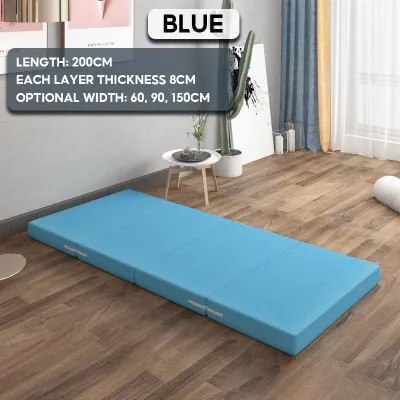




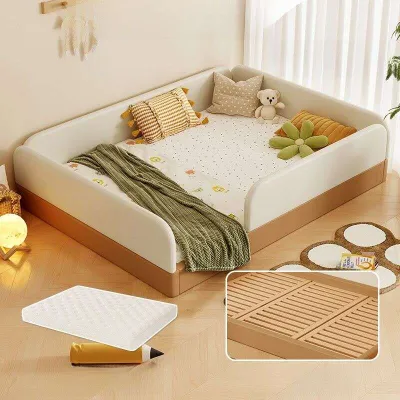
Prices are valid at publication and may change. Please refer to the product page for the latest price.
If the comfort layers of your mattress are too thin or the materials are too rigid, your shoulders and hips cannot sink sufficiently. This lack of give can lead to restricted blood flow, tossing and turning, and morning aches along your pressure points. Choosing a mattress with slightly more surface contouring helps offset this rigid foundation.
Matching Firmness to Sleep Position and Body Weight
Side sleeping puts your entire body weight on the narrowest contact points: the shoulders and hips. On a hard floor, side sleepers generally require a medium to medium-soft mattress. This allows the prominent joints to sink deep enough into the comfort layers to keep the spine straight and relieve pressure.

Back and stomach sleepers distribute their weight more evenly but require consistent support to keep the pelvis aligned with the shoulders. A medium to medium-firm mattress is usually ideal for these positions. It provides enough surface contouring to cushion the shoulder blades and heels while preventing the lower back or hips from sagging too deeply.
Extra-firm mattresses should generally be avoided on the floor, even by stomach sleepers. Without any underlying give from a bed frame, an extra-firm mattress can leave a gap under the lower back, causing muscle strain and joint pressure over time.
Your physical build also changes how you interact with the mattress. Lighter individuals under 60 kg do not compress mattress layers deeply and will need a softer comfort layer to experience any contouring on a solid floor. Conversely, heavier individuals over 90 kg exert more downward force and risk bottoming out against the hard floor. They require a firmer support core or a thicker profile to keep their weight suspended above the solid ground.
Essential Specs Beyond Firmness: Thickness and Airflow
A floor bed mattress must be thick enough to isolate your body from the hard floor. Generally, look for a mattress that is at least 15 to 20 cm thick. Thinner futons or folding mats can work for temporary use, but daily sleeping requires substantial comfort and support layers to prevent you from feeling the floor’s hardness through the material.
In warm, humid environments like Singapore, placing a mattress directly on the floor presents a significant moisture risk. Without the under-bed clearance of a frame, body heat and sweat can become trapped beneath the mattress, leading to condensation on cold tile or vinyl floors. This dampness is a breeding ground for mold, mildew, and dust mites.
To mitigate moisture issues, look for mattresses with breathable open-cell foam, natural latex, or pocket springs that facilitate air movement. The bottommost layer of the mattress must also be highly durable. High-density polyfoam or robust pocketed coils are essential to withstand constant, direct compression against the unyielding floor without sagging or flattening prematurely.
Setup, Testing, and Moisture Management
When setting up your floor bed, use the first few weeks as a trial period to evaluate your spinal alignment. Lie down in your typical sleeping position and pay attention to your lower back and shoulders. If you wake up with lower back stiffness, the mattress may be sagging too much; if your shoulders or hips feel bruised or numb, the setup is too firm.
To protect your home and health, perform routine moisture checks. Lift the mattress at least once a week to inspect the underside for dampness. If your floor is prone to humidity, place a breathable tatami mat, a moisture-barrier underlay, or a low-profile roll-out slatted base beneath the mattress to restore essential airflow.
Regularly rotate the mattress 180 degrees every few months to ensure even wear across the comfort layers. Vacuuming the floor beneath the bed weekly is also crucial, as dust and allergens accumulate much faster at floor level than on an elevated frame.
Frequently Asked Questions (FAQ)
Can I use my existing mattress on the floor?
You can, but you must check a few details first. Assess if the mattress feels comfortable when laid on the floor, as its firmness will increase. Crucially, check your manufacturer’s warranty, as many brands void their warranties if the mattress is placed directly on the floor without a slatted base. If your current mattress is under 15 cm thick or already showing signs of sagging, it is not suitable for direct floor use.
Do I need a special type of mattress for a floor bed?
No special floor-only mattress is required; standard retail mattresses work well if they meet the thickness and breathability criteria. However, avoid exceptionally thick or heavy hybrid mattresses. These are incredibly difficult to lift, flip, or prop up, making the essential routine of cleaning the floor and airing out moisture highly impractical.
Community discussion
Share your experience or ask a question. Comments are reviewed before publication.