
Selecting the perfect entryway furniture is a balance of practical utility and spatial harmony. When looking to buy a shoes rack with seats, the decision goes beyond simple aesthetics; it requires a calculated assessment of your household’s daily shoe habits and the physical limits of your entryway. In Singapore’s compact HDB flats and condominiums, every square centimeter counts. A rack that is too small leads to cluttered floors, while an oversized bench blocks vital walkways. By matching your household size to the correct storage capacity and verifying your entryway’s dimensions, you can find a stable, functional piece that keeps your home organized and welcoming.
Quick Guide to Shoes Rack with Seats Capacity and Space Matching
To find the right balance, start with a simple calculation: estimate that each household member needs space for 3 to 4 pairs of daily-use shoes at the entrance. Unlike standard, ultra-slim shoe cabinets that can be as shallow as 15 to 25 centimeters, a shoes rack with seats requires a deeper footprint. Because it must serve as a stable seating platform, it typically demands a depth of 35 to 40 centimeters to accommodate a sitting adult safely.
The decision path is straightforward but requires precision. First, calculate the total number of shoe pairs that must live at the entryway. Second, measure your entryway’s width and depth, paying close attention to door swings and clearance. Finally, select a configuration—whether a low-profile two-tier bench or a tall modular cabinet—that fits your storage needs without narrowing your home’s main thoroughfare.
Products mentioned in this guide
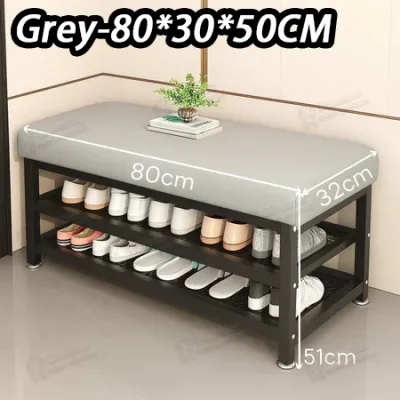
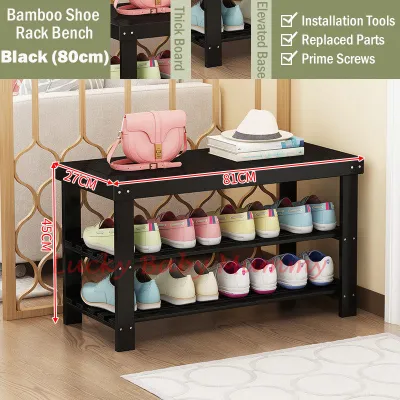
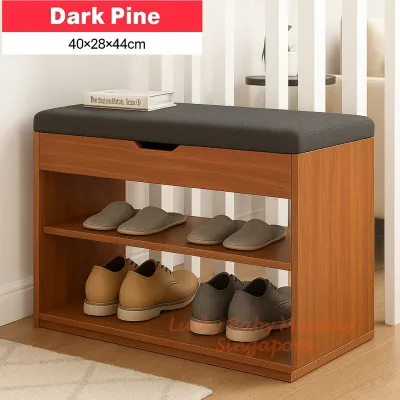
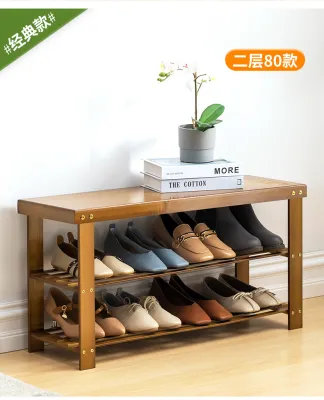
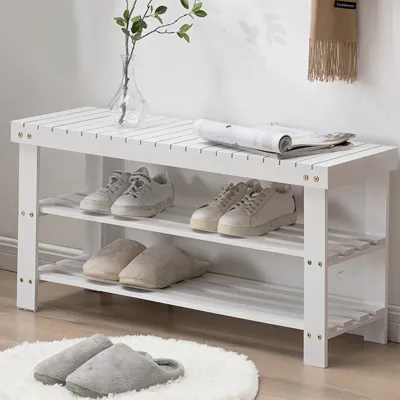
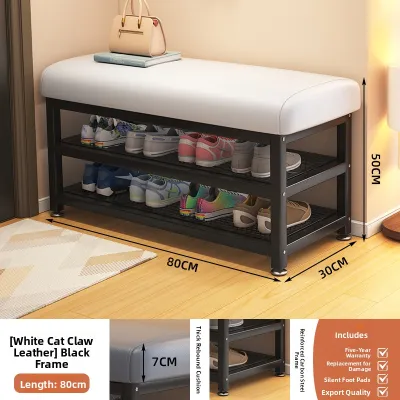
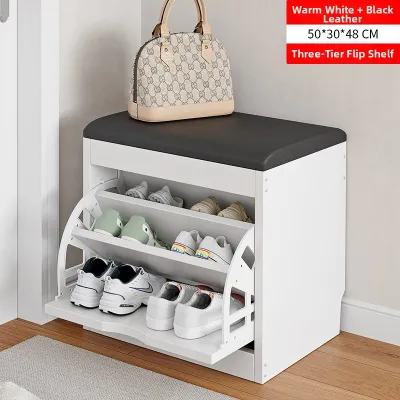
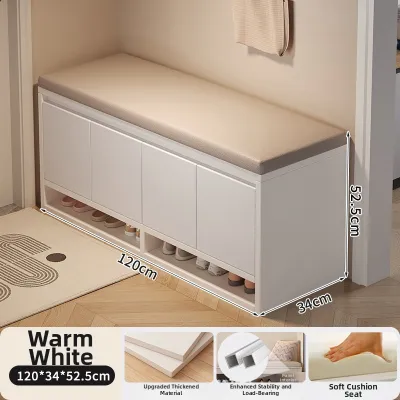
Prices are valid at publication and may change. Please refer to the product page for the latest price.
Calculating Shoe Storage Needs by Household Size
To avoid buying a shoe rack that quickly overflows, start by auditing your household’s active footwear. Count only the shoes that are worn regularly—such as work shoes, school shoes, daily sneakers, and casual sandals. Off-season footwear, formal wear, and specialty sports gear should be stored in secondary closets or bedroom wardrobes. As a baseline, allocate storage for 3 pairs per adult and 2 pairs per child.

Your family’s demographic significantly influences your storage layout. For families with young children, keep in mind that kids’ shoes are small but numerous. While you can often double-stack children’s shoes on a single shelf, you must also plan for rapid growth and frequent size changes. Ensure the lowest tiers of the rack are easily accessible so young children can independently reach and put away their footwear.
For active households, standard shelf spacing may not suffice. Running shoes, basketball high-tops, and hiking boots are bulky and require more vertical clearance (often 15 to 20 centimeters) and wider shelf space than flat sandals. If your family participates in outdoor sports, ensure your rack has adjustable shelves or dedicated taller compartments to prevent crushing expensive athletic footwear.
A welcoming entryway should always reserve space for guests. Allocate room for at least 2 to 4 pairs of guest slippers near the bottom. Additionally, look for seating racks that feature built-in utility storage. Small drawers, side pockets, or under-seat compartments are incredibly useful for holding everyday items like shoe horns, keys, umbrellas, and shoe cleaning brushes, keeping these accessories out of sight but within easy reach.
Measuring Your Entryway for a Shoe Rack with Seat
Before browsing designs, take exact physical measurements of your entryway. A standard shoe cabinet can be quite thin, but a seating bench must be deeper to remain stable and comfortable. Ensure you have a clear wall space that can accommodate a depth of 35 to 40 centimeters. The width of the unit should align with your wall length, leaving enough clearance so it does not overlap with door frames, light switches, or electrical outlets.
In Singapore’s high-density housing, main doors and metal gates often swing inward or outward in close proximity. Carefully map out the swing arc of your front door and any adjacent closet or kitchen doors. The shoe bench must not obstruct these doors from opening to at least 90 degrees. Furthermore, maintain a clear walkway width of at least 90 centimeters in front of the rack. This ensures that when someone is seated to put on their shoes, other family members can still pass by safely without squeezing.
If you are considering a tall, high-capacity cabinet-style rack with an integrated bench, vertical clearance is critical. Check the wall for overhead obstacles such as electrical distribution boards (DB boxes), smart home hubs, intercom systems, light switches, or decorative wall sconces. Measure the height from the floor to these fixtures to ensure the top of the cabinet does not block access to essential household controls.
Examine the floor surface where the rack will stand. Many entryways, especially in older HDB flats or near external corridors, may have slight slopes, uneven floor tiles, or raised thresholds. Because a seating rack must bear dynamic human weight, any floor unevenness can cause the bench to wobble, compromising safety. If your floors are not perfectly level, prioritize shoe racks equipped with adjustable leveling feet to ensure a stable, wobble-free seating surface.
Matching Capacity to Available Space: Configurations and Dimensions
Finding the right fit means translating your calculated shoe count and physical measurements into a specific furniture configuration. The goal is to maximize storage capacity without overwhelming the visual and physical space of your entryway.
Compact Configurations for 1-2 People
For single professionals, couples, or those living in compact studio apartments and smaller BTO flats, a low-profile, two-tier seating bench is often the ideal choice. These compact units typically hold 6 to 10 pairs of adult shoes. They feature a comfortable top cushion with two open shelves below. To keep these smaller units stable and prevent them from becoming top-heavy, place heavier footwear, like work boots or thick-soled sneakers, on the bottom shelf to lower the overall center of gravity.
Mid-Sized Solutions for 3-4 People
Average-sized households require a balance between practical storage capacity and comfortable seating space. A mid-sized solution usually consists of a wider two-tier bench or a standard three-tier rack, accommodating 12 to 20 pairs of shoes. Many of these designs measure between 80 and 120 centimeters in width. To optimize this footprint, look for configurations that incorporate side shelves for taller footwear or small pull-out drawers directly under the seat cushion to store daily essentials.
High-Capacity Setups for 5 or More People
Large, multi-generational families require maximum storage capacity. For these households, a simple bench is rarely enough. Instead, opt for tall entryway cabinets that feature a built-in, recessed bench seat, or modular expandable units that can store 20 or more pairs of shoes. Because these units are tall and heavy, safety is paramount. You must securely anchor high-capacity cabinets to the wall using L-brackets or heavy-duty wall anchors to eliminate any risk of tip-over accidents when family members sit or stand.
Evaluating Weight Capacity and Stability
When purchasing a shoe rack designed for sitting, you must evaluate its structural integrity. Unlike a standard display shelf, a seating bench must withstand dynamic loads—the sudden impact of a person sitting down. Always check the manufacturer’s specified weight capacity, which should ideally be at least 100 to 120 kilograms for a single seat, and up to 150 kilograms or more for wider benches. Look for frames made of solid wood, welded metal, or high-density engineered wood with reinforced joints. Avoid flimsy plastic frames or thin, unreinforced particle board, as these materials can warp or fail under repeated use.
Common Sizing and Placement Mistakes to Avoid
- Underestimating Seat Depth: A common mistake is buying a shoe bench that is too shallow (under 30 centimeters) to save space. A shallow bench makes sitting uncomfortable and causes larger adult shoes to protrude past the shelves, creating a constant tripping hazard in your entryway.
- Ignoring Ventilation: Enclosed shoe cabinets can trap moisture, sweat, and humidity, which are abundant in Singapore's tropical climate. Storing damp or worn shoes in an unventilated cabinet quickly leads to mold growth and stubborn odors. To prevent this, choose designs with louvered doors, open-back frames, or breathable wire mesh shelves that promote continuous airflow.
- Overloading Beyond Specifications: Never treat a lightweight, decorative shoe organizer as a primary seating bench. Sitting on a unit that is not explicitly rated for human weight will loosen the joints over time, causing the shelves to sag and the frame to eventually collapse.
- Blocking Safety Routes: In high-rise living, keeping evacuation routes clear is a critical safety requirement. Ensure your shoe rack is positioned so it does not narrow the main exit path or block the front door from opening fully. In an emergency, every second counts, and a poorly placed bench can become a dangerous obstacle.
Frequently Asked Questions (FAQ)
How much weight can a typical shoe rack seat support?
Weight capacities vary significantly based on the materials and construction quality of the bench. Standard light-duty metal or engineered wood shoe benches typically support between 80 and 100 kilograms. Heavy-duty benches constructed with solid wood frames or reinforced steel can support 120 to 150 kilograms or more. Always check the manufacturer’s specified load limit before purchasing, and inspect the joints for reinforcement brackets to ensure long-term structural safety.
Can I add a seat cushion to my existing standard shoe rack?
It is highly discouraged to place a loose seat cushion on a standard shoe rack to use it as a bench. Standard shoe racks are engineered solely to support the static weight of lightweight footwear, not the dynamic weight of a sitting adult. Attempting to sit on a non-reinforced rack can cause the shelves to buckle, the joints to snap, or the entire unit to tip over. Instead, purchase a purpose-built seating rack designed and structurally verified to handle human weight safely.
Community discussion
Share your experience or ask a question. Comments are reviewed before publication.