
Quick Answer: Is Haworth the Right Premium Chair for Your Home Office?
Haworth is a major force in high-end seating, competing directly with tier-one brands like Herman Miller and Steelcase. For home offices, Haworth models—most notably the Fern, Zody, and Very—represent a highly competitive combination of responsive ergonomic support, modern residential aesthetics, and industrial-grade build quality. However, whether a Haworth chair is your best choice depends on your unique physical proportions, preferred sitting postures, and home workspace constraints.
To make an informed decision, you must evaluate several key dimensions rather than relying on brand reputation alone. These critical factors include the precise range of mechanical adjustability, how well the chair’s visual footprint and materials blend into a residential setting, and the practicalities of local retail availability, warranty coverage, and after-sales support in Singapore.
Ergonomic Adjustability: Comparing Haworth to Rival Brands
Premium ergonomic chair design generally splits into two distinct philosophies. Some manufacturers focus on dynamic, passive ergonomics—where the chair automatically adjusts to your movements using flexible frames and tension-balanced materials. Others prioritize active, highly adjustable mechanical support, allowing you to manually dial in the exact tension, height, and angle of every component. Haworth’s flagship models bridge these philosophies by combining flexible, responsive backrests with precise manual overrides.
Products mentioned in this guide
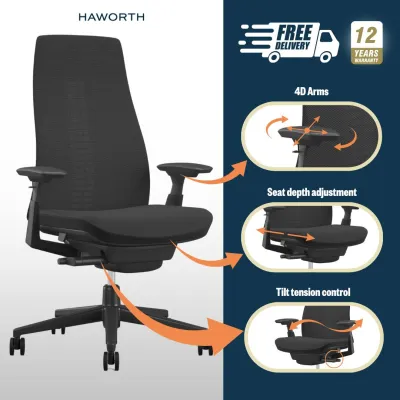
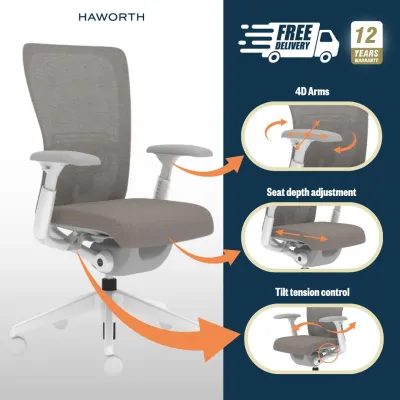
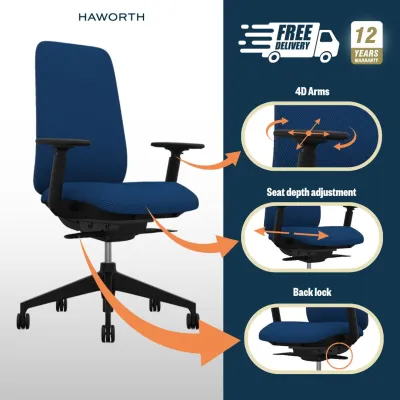
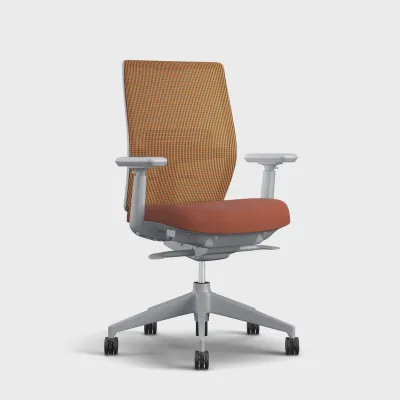
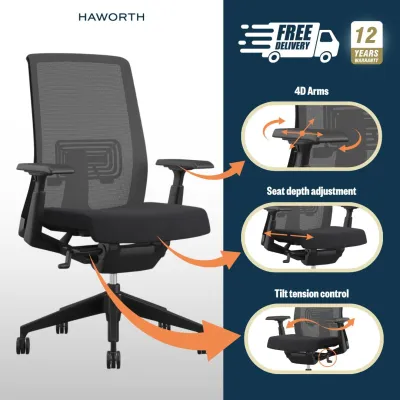
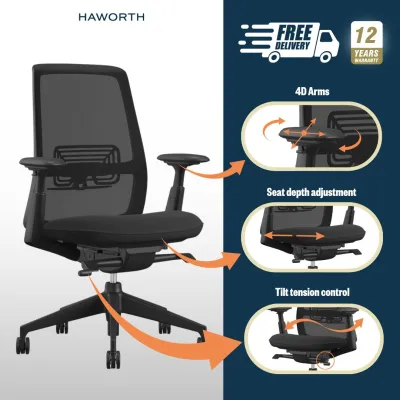
Prices are valid at publication and may change. Please refer to the product page for the latest price.

When comparing premium brands, look past proprietary marketing jargon and analyze the actual mechanical specifications. Reviewing the manufacturer’s official technical sheets for adjustment ranges, lockable angles, and physical dimensions is the only reliable way to verify if a chair will support your body throughout a long working day.
Core Support Mechanisms: Lumbar, Tilt, and Seat Depth
The foundation of any ergonomic chair lies in how it supports your spine and pelvis. Lumbar support is a critical point of differentiation. Haworth is highly regarded for its optional, independently adjustable lumbar support systems. For instance, the Haworth Zody features an asymmetrical lumbar adjustment mechanism, allowing you to set different support levels for the left and right sides of your lower back. This is highly beneficial for users with asymmetrical muscle tension. In contrast, many competitors rely on uniform mesh tension or a single horizontal foam pad that only adjusts vertically. When comparing options, check whether the lumbar support can be adjusted for both height and depth, and verify if the tension feels supportive without creating localized pressure points.
Recline and tilt mechanisms dictate how the chair moves as you shift postures. Most premium chairs utilize a synchro-tilt mechanism, where the backrest reclining rate relative to the seat pan is typically a 2:1 ratio to keep your feet flat on the floor. You should verify the number of tilt-lock positions and the behavior of the tilt tension. Haworth models often provide a back-stop or tilt-limiter rather than a rigid multi-position lock, encouraging continuous, micro-movements that promote blood circulation. If you prefer to lock your chair at a specific forward-tilted angle for intense typing tasks, confirm whether the specific model you are evaluating supports forward tilt, as this is often an optional upgrade rather than a standard feature.
Seat depth adjustment is equally vital for maintaining proper lower-body circulation and pelvic alignment. A seat pan that is too deep will press against the back of your knees, causing you to slide forward and slouch, while a seat that is too shallow fails to support your thighs adequately. Look for a slider mechanism that offers at least 50 to 75 millimeters of travel. When testing or reviewing specifications, ensure the seat depth can be adjusted so that a gap of approximately two to three fingers remains between the front edge of the seat cushion and the back of your knees.
Extremity Support: Armrests, Headrests, and Body Fit
Proper support for your upper extremities and head reduces tension in the neck, shoulders, and upper back. Armrests on premium chairs should ideally offer “4D” adjustability: height, width, depth, and pivot angle. Haworth’s 4D armrests are widely praised for their generous adjustment ranges and soft, polyurethane pads that cushion the elbows without bottoming out. When comparing brands, pay close attention to the minimum and maximum armrest widths. If you have a narrower torso, armrests that do not slide inward sufficiently will force you to splay your elbows, straining your rotator cuffs. Conversely, broader users must verify that the armrests can be adjusted outward to prevent restriction.
Headrests remain a polarizing topic in ergonomic design. Many high-end office chairs are engineered to support the spine so effectively that a headrest is deemed unnecessary for upright working postures. Consequently, brands like Haworth often treat headrests as optional add-ons, or omit them entirely on certain models. If you enjoy reclining during phone calls or creative brainstorming sessions, check whether a native headrest is available and if its height and depth can be adjusted independently of the backrest. Be aware that aftermarket, third-party headrests are common for some rival brands, but using them can sometimes void your manufacturer’s warranty.
Ultimately, overall body fit overrides any individual feature. A premium chair must accommodate your specific height and weight. While some brands use a multi-size approach (offering distinct small, medium, and large frame sizes), Haworth typically designs its chairs with highly adjustable, single-size frames intended to accommodate a broad spectrum of users (often ranging from the 5th to the 95th percentile of body types). To verify compatibility, cross-reference the chair’s maximum weight capacity—typically rated up to 150 kilograms for premium models—and the absolute seat height range against your desk height and leg length.
Build Quality, Materials, and Home Environment Fit
A premium ergonomic chair is a significant investment, making material durability and structural integrity paramount. The choice of upholstery is a primary factor in both comfort and longevity. Haworth utilizes high-performance knit and mesh materials, such as the digital knit on the Fern, which offers a soft, fabric-like feel while maintaining the breathability of a traditional mesh. When evaluating mesh and fabric options across different brands, do not assume that a high price tag automatically guarantees resistance to wear, sagging, or tearing. Instead, look for objective testing data, such as the Martindale or Wyzenbeek abrasion rating. Premium commercial-grade fabrics should easily exceed 100,000 double rubs. Additionally, review the manufacturer’s care instructions; some high-performance meshes require specialized cleaning agents, while others can be easily wiped down with a damp, lint-free cloth.
Underneath the upholstery, the frame and base construction determine the chair’s structural stability. High-end chairs generally offer a choice between reinforced glass-filled nylon (plastic) frames and polished or powder-coated aluminum frames. Aluminum bases provide superior long-term durability and resistance to scuffing, but they add weight and increase the overall cost. Regardless of the material, verify that the base is wide enough to prevent tipping when you lean fully back. The casters must also match your home flooring. Hard casters are designed to roll smoothly on carpets but can scratch and gouge hardwood, vinyl, or engineered flooring. Soft casters, typically coated with polyurethane, provide necessary grip and protect hard surfaces.
In a residential setting, aesthetics and spatial constraints are critical considerations that differ from commercial office planning. Many premium ergonomic chairs have a distinctly corporate, industrial appearance that can clash with home decor. Haworth addresses this by offering extensive customization options, including white or warm-toned frames, and a wide variety of upholstery colors that help the chair blend into a modern Singaporean apartment. You must also consider the physical footprint of the chair. Measure your designated workspace carefully, taking into account the outer width of the base and the maximum height of the backrest. In compact study corners or dual-purpose bedrooms common in Singapore’s high-density housing, a chair with a massive visual profile or an extra-wide base can make the room feel cramped and restrict movement around other furniture.
Environmental responsibility is another hallmark of premium manufacturing. To verify sustainability claims, avoid relying on vague marketing buzzwords. Instead, check the product documentation for recognized third-party environmental certifications. Look for certifications such as GREENGUARD Gold (which ensures low chemical emissions for healthier indoor air quality), BIFMA level® (which assesses multi-attribute sustainability standards), or Cradle to Cradle certification. These standards confirm that the chair has been manufactured using safe materials, is energy-efficient to produce, and is designed for easy disassembly and recycling at the end of its lifespan.
Evaluating Value: Warranties, Maintenance, and Local Availability
Understanding the total cost of ownership requires looking beyond the initial purchase price. Premium ergonomic chairs are typically sold using a tiered pricing structure. The base model often features basic plastic components, fixed armrests, and standard fabric, while upgrading to 4D armrests, adjustable lumbar support, an aluminum base, and premium knit upholstery can increase the price significantly. When comparing brands, ensure you are comparing equivalent configurations. In Singapore, it is highly recommended to purchase directly from authorized local distributors or official brand stores. While importing a chair from overseas or buying from parallel importers might seem cost-effective initially, it often leads to severe complications. Parallel imports rarely carry local warranty coverage, and the cost of shipping a heavy, bulky item back to an overseas seller for repairs can easily exceed the initial savings.
The warranty is one of the strongest arguments for investing in a premium brand. Companies like Haworth typically offer robust warranties, often spanning up to 12 years for structural components, frames, and mechanisms, with shorter periods (typically 3 to 5 years) for seating foam, mesh, and fabrics. However, you must read the fine print of the warranty agreement. Verify whether the warranty covers both parts and labor, and whether it is rated for 24/7 multi-shift usage or standard 8-hour single-shift usage. Some manufacturers reduce the warranty duration if the chair is used in a commercial environment or home office that operates around the clock.
Long-term maintenance and repairability are essential for ensuring your chair lasts for over a decade. Over years of daily use, components like casters, armrest pads, and gas cylinders will naturally wear out. Before purchasing, confirm with the local Singapore retailer whether they stock proprietary replacement parts and offer repair services. A brand that provides easily sourceable replacement components and clear maintenance guides is far more valuable than one that requires replacing the entire chair over a single damaged armrest pad or a failing gas lift cylinder. Routine maintenance should also be straightforward; check if the frame joints require periodic tightening and if the mesh can be vacuumed without trapping dust deep within the weave.
How to Choose: Decision Framework for Home Office Buyers
To select the ideal premium ergonomic chair for your home office, use this targeted decision framework to match your specific requirements to the right brand.
Choose Haworth if:
- You require highly precise, customizable lumbar support, particularly if you benefit from asymmetrical adjustment to target specific lower-back tension.
- You want a modern, residential aesthetic, such as the organic, leaf-like backrest design of the Fern, combined with a wide palette of frame and fabric colors that blend seamlessly into your home decor.
- You value a flexible backrest that moves dynamically with your body as you twist, stretch, or change angles throughout the day.
- You have access to an authorized local distributor in Singapore that offers comprehensive local warranty coverage and reliable after-sales support.
Choose a Competitor if:
- You prefer a rigid, highly structured posture-correction system that firmly holds your spine in a single, scientifically optimized alignment without much lateral flexibility.
- You require a native, fully integrated headrest included in the standard package without paying for an expensive optional add-on.
- Your home office has extreme space constraints that require a chair with an exceptionally small base diameter or a low-profile backrest to fit under a compact desk.
Verify First if:
- You are considering buying a refurbished, second-hand, or parallel-imported chair. Always check the seller’s return policy, confirm whether the original manufacturer's warranty is transferable (most premium warranties are non-transferable and apply only to the original purchaser), and verify if the chair comes fully assembled.
- You are purchasing from online marketplaces. Ensure the seller is an authorized dealer to avoid counterfeit parts or models with stripped-down adjustment mechanisms sold under the same model name.
Actionable Next Steps: Never finalize your purchase based on online reviews or photos alone. Visit a local showroom in Singapore to test your shortlisted chairs in person. When testing, sit in the chair for at least 15 to 20 minutes. Adjust the chair to your exact body measurements and mimic your typical working postures—whether that is upright typing, slightly reclined reading, or taking video calls. Finally, measure your home office setup, paying close attention to your desk height, the clearance between your desk drawers, and the width of your doorways and lift entryways to ensure a seamless delivery and installation process.
Frequently Asked Questions (FAQ)
Do premium ergonomic chairs require complex assembly?
Most premium ergonomic chairs purchased through authorized local dealers in Singapore are delivered fully assembled and ready for immediate use. The manufacturer typically ships them in large, heavy-duty boxes where the seat, backrest, and base are already integrated and tested for quality assurance. If you purchase a model that requires assembly, the process is generally straightforward, typically involving slotting the gas cylinder into the five-star base and securing the seat mechanism with a few heavy-duty bolts using an included hex key. To avoid any physical strain or assembly errors, always check if your local retailer offers white-glove delivery services, which typically include professional assembly, product inspection, and the removal of all bulky packaging materials.
Can I use a premium office chair on hard flooring without a protective mat?
You can use a premium office chair on hard flooring without a protective mat, provided the chair is equipped with the correct type of casters. Standard hard nylon casters are designed specifically for carpeted floors; using them on hardwood, laminate, vinyl, or polished concrete can cause scratches, scuffs, and premature wear. For hard surfaces, you must verify that your chair is fitted with soft, non-marring polyurethane-coated casters. These soft casters provide quiet rolling, gentle grip, and prevent surface damage. If your chair comes standard with hard casters, ask your local Singapore dealer to swap them for soft casters before delivery, or consider placing a high-quality protective chair mat or low-pile rug under your workspace to safeguard your flooring.
Community discussion
Share your experience or ask a question. Comments are reviewed before publication.