
Finding the absolute best brand for a custom mobile kitchen island in Singapore depends on your specific household priorities rather than a single, universally superior provider. If your goal is a seamless visual match with your existing kitchen cabinets, bespoke dimensions, and premium stone countertops, local custom carpentry firms or interior design studios offer the most tailored solutions. Conversely, if you prioritize transparent pricing, standardized quality control, and shorter lead times, modular kitchen brands provide highly functional, semi-custom alternatives.
Crucially, a truly successful mobile island relies on specialized heavy-duty locking casters and reinforced base frames. Because standard kitchen cabinet brands typically design units to sit on static plinths or legs, you must verify whether a provider can engineer a safe, mobile base that remains stable during active food preparation.
Understanding the Scope: Custom vs. Off-the-Shelf Mobile Islands
Before comparing providers, it is essential to distinguish a custom mobile kitchen island from a mass-produced kitchen trolley or butcher block cart. While off-the-shelf trolleys are readily available and highly budget-friendly, they often lack the structural integrity, storage volume, and premium finishes required of a primary kitchen workspace. A custom mobile island is built to the exact height of your existing countertops, utilizes high-grade cabinet carcasses, and features substantial countertop materials like quartz or solid surface.
Products mentioned in this guide
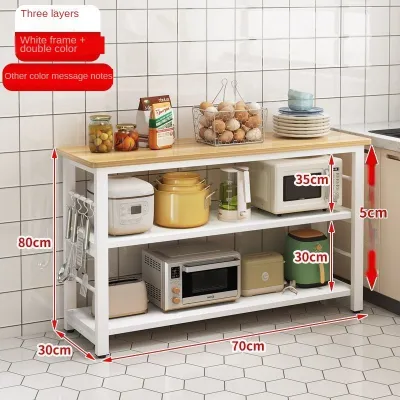
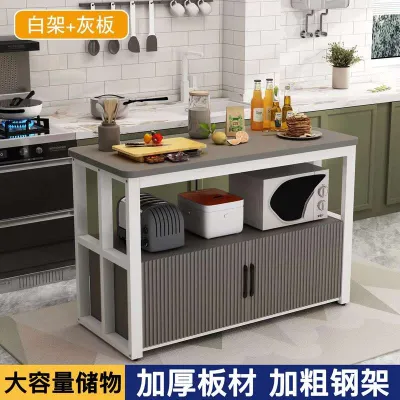
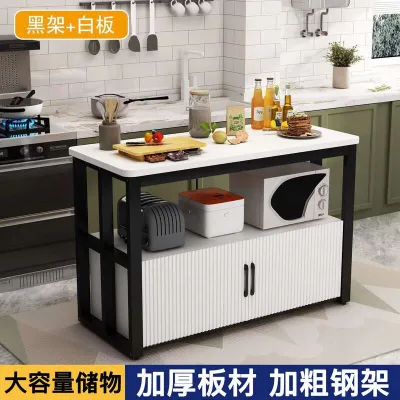
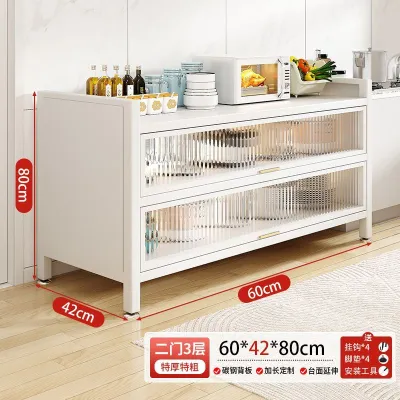
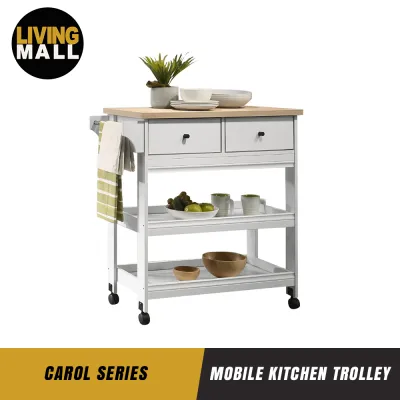
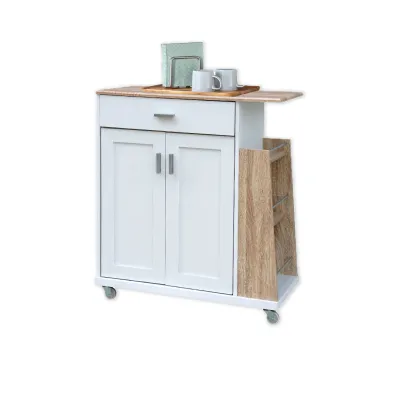
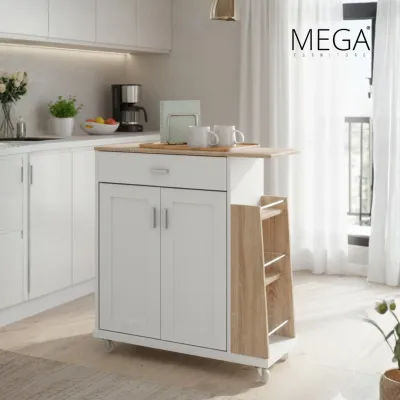
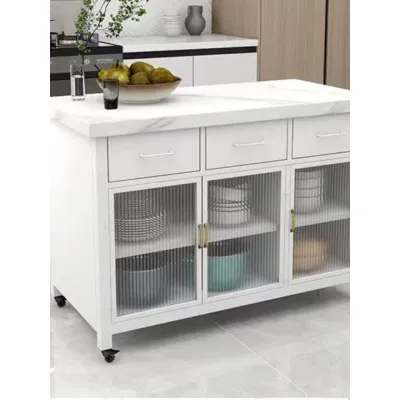
Prices are valid at publication and may change. Please refer to the product page for the latest price.
Mobility introduces unique engineering demands that standard static cabinets do not face. A mobile island requires heavy-duty, 360-degree swiveling casters with robust locking mechanisms to ensure the unit does not shift during tasks like chopping or kneading. The base frame must be reinforced to distribute weight evenly, preventing the unit from becoming top-heavy and tipping over when drawers are fully extended or when heavy appliances are placed on the countertop.
In Singapore’s residential landscape, these mobile units serve distinct spatial purposes. In compact HDB BTO flats or condominium kitchens, a mobile island provides an adaptable prep station that can be rolled away to clear walkways when hosting guests. In open-concept layouts, it acts as a flexible room divider or an informal dining counter. For tenants in rental properties, a mobile island offers the luxury of additional storage and workspace without violating lease agreements through permanent, built-in alterations.
Evaluating Singapore Provider Types for Custom Mobile Islands
To find the right builder, you must evaluate the two primary provider categories in Singapore: bespoke local carpentry firms and modular kitchen brands. Each category operates on a different manufacturing model, carrying distinct advantages and trade-offs.

Local Custom Carpentry and Interior Design Firms
Bespoke carpentry firms and interior designers design and build your mobile island from scratch. This approach offers unparalleled design freedom. If you want your mobile island to match your existing kitchen cabinets perfectly, a custom carpenter can source identical laminates, edge-banding, and hardware. They can also accommodate highly specific dimensions, custom countertop overhangs for bar stool seating, and complex cutouts for integrated appliances.
However, bespoke carpentry comes with a higher price point and longer lead times, typically ranging from four to eight weeks. Because local carpenters traditionally default to building cabinets on fixed concrete plinths or static plastic legs, you must explicitly request mobility hardware. You will need to verify that the carpenter understands how to construct a reinforced wooden or steel sub-frame to house the casters securely. Additionally, ensure they check that the finished unit can clear your home’s doorway and lift access during delivery, as bespoke islands are usually delivered fully assembled.
Modular Kitchen and Specialty Furniture Brands
Modular kitchen providers and specialty furniture brands offer semi-custom configurations built from pre-fabricated cabinet modules. You can select from a set menu of cabinet widths, drawer configurations, and finishes to assemble an island that fits your space. This standardized manufacturing process ensures consistent quality control, highly durable factory-applied edge-bandings, and transparent, upfront pricing. Lead times are also significantly shorter than bespoke carpentry.
The trade-off lies in the limits of customization. You are generally restricted to standard modular widths (such as 400mm, 600mm, or 800mm) and cannot easily request custom depths or non-standard appliance cutouts. More importantly, you must verify whether the brand’s modular base cabinets are structurally rated to support heavy-duty casters. Standard modular legs distribute weight directly downward, whereas casters exert lateral stress on the bottom panel of the cabinet when the island is moved. Ensure the provider offers an official mobile base kit or confirms that their carcasses are reinforced for caster installation.
Key Comparison Metrics: Customization, Materials, and Pricing
When comparing quotes from different Singapore providers, you need an objective framework to evaluate their proposals. Focus on functional configuration, material specifications, and the transparency of their pricing breakdowns.
Customization and Functional Configuration
A well-designed mobile island must balance storage, seating, and utility. If you plan to use the island as a breakfast mains or dining counter, ensure the provider can engineer a countertop overhang of at least 250mm to 300mm to allow comfortable legroom. This overhang requires careful counter-balancing or support brackets to prevent the island from tipping when weight is applied to the edge.
Evaluate the internal storage options offered by each brand. Deep tandem drawers with soft-close runners are highly efficient for storing heavy pots and pans, while pull-out spice racks or pantry units maximize narrow spaces. If you intend to use small kitchen appliances like stand mixers or microwaves on the island, ask how the provider handles power. While a static island can have standard electrical points, a mobile island requires specialized solutions, such as integrated rechargeable power stations or dedicated channels for heavy-duty extension cords.
Material Quality and Hardware Durability
Do not rely on generic marketing terms like “waterproof” or “scratch-resistant.” Instead, ask for specific material classifications and check the manufacturer’s care instructions.
- Cabinet Carcasses: For kitchen environments prone to high humidity, look for moisture-resistant (MR) MDF, high-pressure laminates (HPL), or marine-grade plywood. Ensure the interior joints are reinforced and the edge-banding is seamlessly applied to prevent water ingress from spills.
- Countertop Materials: Sintered stone and quartz are highly popular in Singapore for their durability and low porosity, but they are heavy. If you choose these materials, the cabinet frame must be robust enough to support the weight, and the casters must have a matching load capacity.
- Caster Hardware: This is the single most critical component of a mobile island. The casters must be rated for the total estimated weight of the island (including the countertop and stored items). Look for non-marking polyurethane or rubber wheels that will not scratch delicate flooring. The braking mechanism should lock both the wheel rotation and the swivel direction to ensure absolute stability during use.
Pricing Structures and Quotation Breakdown
To compare offers accurately, request an itemized quotation that separates the cost of each component. A transparent quote should clearly break down the following:
- Base Carpentry: The cost of the cabinet carcasses, doors, and internal shelving.
- Countertop Fabrication: The cost of the stone or solid surface material, including edge profiling and polishing.
- Hardware and Accessories: Itemized costs for drawer runners, hinges, and the heavy-duty caster set.
- Delivery and Assembly: Fees for transporting the unit and assembling it on-site.
In Singapore, a basic modular mobile island with a solid surface top may range from S$800 to S$1,500. A fully custom-carpentered island with a premium quartz countertop, soft-close Blum hardware, and heavy-duty locking casters can range from S$1,800 to S$4,000 or more, depending on the dimensions and material selections.
Spatial Planning and Safety Verification for Singapore Kitchens
Integrating a mobile island into a Singapore home requires careful spatial planning to ensure it does not block traffic or compromise safety.
First, measure your available kitchen space and plan for clearances. You must maintain a minimum walkway clearance of 900mm to 1000mm between the mobile island and your existing countertops, walls, or appliances. This clearance ensures that you can comfortably open oven doors, dishwasher trays, and lower cabinets without obstruction. If your kitchen is narrow, ensure the island’s finished dimensions allow it to be rolled completely out of the main work triangle when not in use.
Second, verify your floor compatibility and access routes. Measure your doorways, hallways, and lift dimensions to ensure the fully assembled island can be delivered into your home. Once inside, the floor surface must be level. While large-format tiles and polished concrete are highly durable, older HDB floors may have slight gradients leading toward floor drains. If your kitchen floor has a slope, a mobile island can drift if the caster brakes are not fully engaged. Additionally, check that the caster wheel material is compatible with your flooring; soft vinyl or engineered wood can indent under heavy, static wheel loads over time.
Finally, perform safety checks once the island is delivered. Verify the unit’s center of gravity by placing your heaviest kitchen appliance on the countertop and fully extending the top drawers. The island must remain perfectly stable without any lifting or swaying. Test the locking strength of the casters by applying vigorous horizontal force—such as mimicking the action of kneading bread—to ensure the brakes hold firm on your specific floor material.
Actionable Selection Framework: Choosing the Right Provider
To guide your purchase of a custom mobile kitchen island, follow this step-by-step selection framework:
- Define Your Spatial Limits: Measure your kitchen's maximum footprint and map out the ideal dimensions of the island, keeping the 900mm walkway clearance in mind. Identify where the island will be parked when not in active use.
- Determine Your Customization Needs: Decide if you require an exact visual match with existing carpentry (favoring local custom carpenters) or if a standalone, complementary design is acceptable (favoring modular brands).
- Request Detailed Quotes: Approach two to three providers. Request itemized quotes specifying the carcass materials (e.g., marine plywood), countertop brands, and the load capacity of the proposed casters.
- Verify Hardware Quality: Visit showrooms to physically test the drawer runners and caster mechanisms. Lock the casters on display models and check for any wobbling or sliding.
- Review the Warranty: Clarify the warranty terms. Ensure the warranty covers not just the cabinetry structure but specifically the moving parts, including the casters and drawer slides, which are subject to continuous wear and tear.
Frequently Asked Questions (FAQ)
Can I integrate power outlets into a mobile kitchen island?
Yes, you can integrate power outlets, but it requires specialized planning. Because a mobile island moves, you cannot use standard hardwired electrical connections. Safe options include installing a heavy-duty retractable cord reel mounted to the ceiling, utilizing a flush floor-mounted pop-up outlet box with a flexible, heavy-duty cable protective chain, or incorporating a high-capacity portable power station within one of the lower cabinets. Always consult both your cabinet maker and a licensed electrician in Singapore to ensure the setup complies with local electrical safety regulations.
Is a mobile island stable enough for heavy food preparation?
A mobile island can be exceptionally stable, but its stability depends entirely on the quality of its casters and its overall weight distribution. To handle heavy tasks like kneading dough or operating a high-speed stand mixer, the island must feature heavy-duty casters where the brakes lock both the wheel rotation and the swivel axle simultaneously. Furthermore, the island’s base should be heavier than its top section to maintain a low center of gravity. Utilizing a heavy carcass material like marine plywood and placing heavy cookware in the bottom drawers will naturally anchor the unit to the floor when locked.
Community discussion
Share your experience or ask a question. Comments are reviewed before publication.