
Selecting a kitchen sink cabinet in Singapore requires balancing your budget with the physical realities of your kitchen layout, plumbing setup, and long-term durability needs. Whether you are renovating a new BTO flat, upgrading a resale HDB, or remodeling a condominium kitchen, the sink cabinet is the hardest-working zone in the space. Because it houses the sink, waste pipes, and often water filtration systems, this cabinet is highly susceptible to moisture, leaks, and wear.
To find the best customization options for your budget, you must choose between three primary provider tiers in Singapore. Budget-conscious homeowners can opt for modular systems from major home improvement retailers, which offer cost-effective, semi-custom setups with fast delivery. Those seeking a perfect fit and tailored storage solutions generally find the best value in local custom carpentry firms and mid-range interior design studios. For homeowners prioritizing luxury materials, advanced engineering, and seamless integration, premium imported bespoke kitchen brands offer fully customized systems tailored to every millimeter of your space.
How to Evaluate Custom Kitchen Sink Cabinet Options
Before committing to a specific brand or carpenter, you need to understand the key customization dimensions that determine both the price and the longevity of your kitchen sink cabinet. A sink cabinet is not merely a box that holds a basin; it is a complex structural unit that must support significant weight, withstand high humidity, and accommodate intricate plumbing.
Products mentioned in this guide
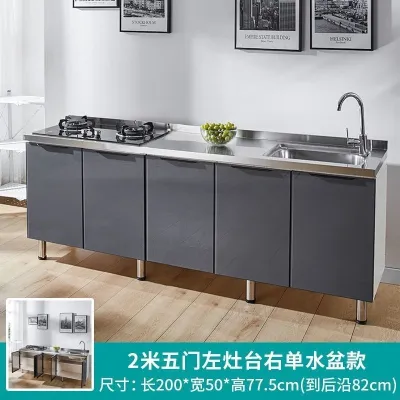
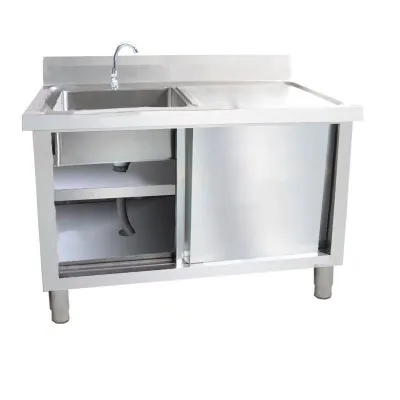
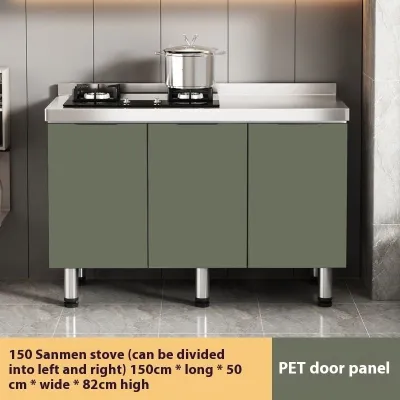
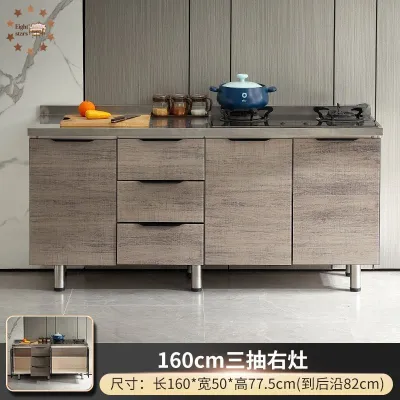
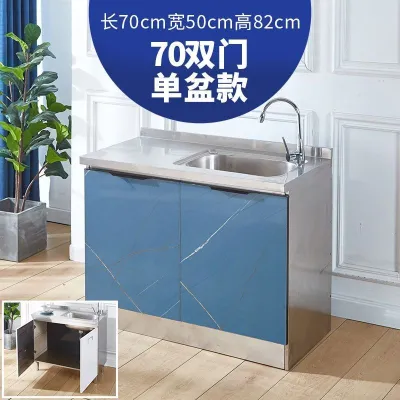
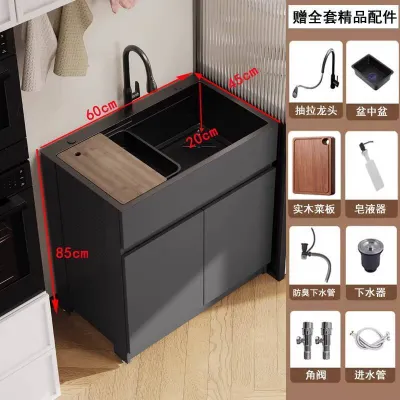
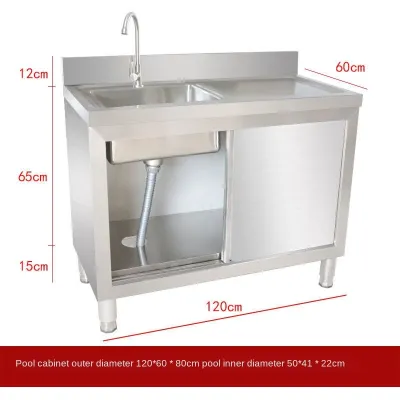
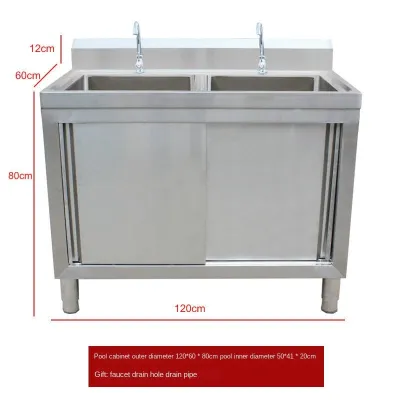
Prices are valid at publication and may change. Please refer to the product page for the latest price.
Key Customization Dimensions
- Carcass Material: The carcass, or the internal cabinet box, forms the structural foundation. While standard cabinets often use melamine-faced chipboard, sink cabinets require materials with high moisture resistance. Common options in Singapore include moisture-resistant plywood, solid PVC boards, or stainless steel linings.
- Countertop Integration: The choice of countertop material—such as quartz, solid surface, sintered stone, or compact laminate—directly affects how the sink is mounted and sealed. Customization allows you to decide how the countertop joins the cabinet carcass to prevent water seepage.
- Sink Mounting Styles: You must decide whether your sink will be top-mounted (sitting on top of the countertop rim), undermounted (installed beneath the countertop for a seamless look), or a farmhouse style (with an exposed front apron). Each mounting style requires specific structural support and sealing techniques within the cabinet carcass.
- Internal Storage Solutions: Customizing the interior allows you to maximize the awkward space around plumbing pipes. Options include built-in pull-out trash bins, custom shelving around U-bends, and dedicated compartments for water filtration systems or instant-hot water dispensers.
How Budgets Impact Customization Your budget tier directly dictates the level of dimensional flexibility, material quality, and hardware engineering you can access. At lower price points, you must work within pre-determined dimensional increments and standard material grades. As you move into mid-range and premium tiers, you gain the ability to customize cabinets to the exact millimeter, select highly durable marine-grade materials, and integrate premium soft-close hardware designed to withstand thousands of opening cycles.
Accounting for Singapore Housing Constraints Singapore’s unique housing landscape introduces specific spatial and structural constraints. HDB flats, particularly newer BTO units, often have compact kitchen footprints or adjacent service yards that limit where plumbing can be routed. Condominium kitchens may feature fixed structural pillars or pre-installed piping layouts that cannot be easily relocated. When planning a custom cabinet, you must work around these fixed elements, ensuring that your custom design does not block access to floor traps or main waste stacks.
Prioritizing Structure Over Cosmetics When allocating your budget, always prioritize structural integrity and moisture management over purely aesthetic upgrades. A beautiful cabinet door or a trendy handle will not compensate for a warped carcass or mold growth caused by poor water sealing. Investing in a high-quality, moisture-resistant carcass and professional edge banding will ensure your kitchen remains hygienic and structurally sound for years to come.
Top Kitchen Sink Cabinet Brands and Providers by Budget Tier
Singapore offers a diverse market of kitchen cabinet providers, ranging from global retail giants to local independent workshops and luxury European showrooms. Understanding what each tier offers helps you align your expectations with your budget.

Budget-Friendly: Modular and Mass-Market Brands
For homeowners looking to minimize costs while achieving a clean, modern aesthetic, modular kitchen brands and large home improvement retailers offer highly practical solutions. These providers specialize in mass-produced cabinet components that can be configured to fit a variety of kitchen layouts.
The scope of customization at this tier is typically semi-custom. Instead of building a cabinet from scratch, you select from a catalog of standardized cabinet widths, heights, and depths. You can choose from a preset range of sink dimensions, standard carcass finishes, and basic internal organizers like wire baskets or standard shelves. The sink mounting is often restricted to top-mount styles, which are easier to install on standard countertops but require careful caulking to prevent water from seeping into the joints.
The primary advantage of modular brands is their affordability and transparency. Pricing is typically modular and clearly listed, allowing you to calculate the exact cost of your setup before purchasing. Because the components are pre-fabricated and stocked in warehouses, lead times are short, often allowing for delivery and installation within one to two weeks.
However, modular systems come with distinct limitations. Because the cabinet dimensions are fixed, they rarely fit the exact width of your kitchen walls perfectly. To bridge the remaining gaps, installers must use filler panels, which can result in slightly wasted space. Additionally, the standard materials used in mass-market cabinets, such as low-density particle board, are highly sensitive to moisture. If the protective laminate or edge banding is compromised, water can cause the wood fibers to swell and degrade rapidly.
Mid-Range: Local Custom Carpentry and Design Studios
The most popular choice for homeowners in Singapore is local custom carpentry, either hired directly or managed through mid-tier interior design studios. This option bridges the gap between mass-market modular limits and high-end luxury, offering tailored solutions built specifically for your home.
Local carpentry workshops build your kitchen sink cabinet from scratch based on precise, on-site measurements of your kitchen. This level of customization allows for millimeter-perfect dimensional adjustments, ensuring that every inch of wall space is utilized and no filler panels are required. It also gives you the freedom to integrate complex plumbing systems, such as built-in water purifiers, food waste disposers, and under-sink water heaters, with custom-cut internal shelving designed around the pipes.
At this tier, you have access to regional board materials that are better suited to Singapore’s humid climate. The standard recommendation for a sink cabinet carcass in local carpentry is high-grade, double-sided color PVC plywood or blockboard. Plywood offers superior structural strength and moisture resistance compared to particle board. When evaluating local carpenters or design studios, it is essential to review their past project portfolios, verify their workshop capabilities, and ask about their specific warranty terms regarding water-related damage or structural sagging.
Moisture protection is the single most critical factor in custom carpentry. You must communicate clearly with your carpenter or designer about the edge banding and sealing techniques they plan to use. Ensure they use high-quality ABS (Acrylonitrile Butadiene Styrene) edge banding on all cabinet doors and exposed carcass edges. ABS trimming provides a durable, impact-resistant seal that prevents water from penetrating the inner wood core, protecting your investment from daily kitchen spills and high humidity.
Premium: High-End and Imported Bespoke Brands
For homeowners with a substantial budget who demand the absolute highest standards of engineering, material science, and design, premium European importers and specialized high-end kitchen showrooms offer unparalleled bespoke services. These brands treat the kitchen as a highly engineered architectural system rather than a collection of wooden boxes.
The customization options at this premium tier are extensive and highly advanced. You can opt for integrated countertops where the sink and the work surface are fabricated from a single, continuous sheet of natural stone, quartz, or solid surface, completely eliminating joints where grime and water can accumulate. The cabinet carcasses themselves are often constructed from innovative, highly waterproof materials, such as marine-grade aluminum, stainless steel, or specialized high-density polymer composites that are entirely immune to water damage and rot.
In addition to superior materials, premium brands offer meticulous spatial planning and professional design services. Every drawer runner, hinge, and internal organizer is engineered for silent, effortless operation, utilizing premium soft-close hardware systems that are rated for decades of heavy use. Custom interior lighting, integrated electrical outlets, and specialized ventilation systems to keep the under-sink area dry are standard features at this level.
The trade-offs for this level of luxury are significant. Premium imported kitchens carry a substantial price tag and require long lead times, often taking three to six months from the final measurement to delivery, as the components are custom-manufactured overseas and shipped to Singapore. Furthermore, these systems require a highly precise site environment; the kitchen walls and floors must be perfectly level and plumb before installation can begin, which may require extensive preparatory masonry work by your main contractor.
Comparing Customization Features Across Provider Tiers
To help you decide which provider tier aligns best with your renovation timeline, design aspirations, and budget, it is helpful to compare their capabilities side by side. Each tier represents a distinct set of trade-offs between cost, flexibility, and lead times.
The following table outlines the typical characteristics of each provider tier available in Singapore.
| Provider Tier | Dimensional Flexibility | Material and Finish Options | Sink Integration Capabilities | Typical Lead Time | Warranty Focus |
|---|---|---|---|---|---|
| Budget-Friendly | Low (Standardized modular widths) | Limited (Preset laminates and colors) | Primarily top-mount; limited undermount options | 1 to 2 weeks | Basic structural defects only |
| Mid-Range | High (Millimeter-perfect custom fit) | Wide (Regional laminates, plywood, PVC) | Top-mount, undermount, and custom cutouts | 4 to 8 weeks | Workmanship and moisture-related warping |
| Premium | Fully Bespoke (Architectural integration) | Luxury (Stainless steel, aluminum, stone) | Seamless integrated sinks and flush-mounts | 3 to 6 months | Comprehensive long-term hardware and material warranties |
When interpreting this table, consider your specific kitchen layout and renovation timeline. If you are working on a tight schedule to move into a rental or a BTO flat, a budget-friendly modular system or a local carpenter with a fast turnaround may be necessary. If you have a highly non-standard kitchen layout with angled walls or exposed structural columns, the dimensional flexibility of mid-range carpentry or premium bespoke systems becomes essential to avoid awkward gaps.
It is important to remember that a higher price tag does not automatically guarantee superior moisture resistance. Even the most expensive premium cabinet can suffer from water damage if the installation is rushed or if the joints are not sealed properly. Regardless of the tier you choose, you must verify the specific sealing methods, adhesive quality, and installation practices used by the installers to ensure long-term protection against Singapore’s humid climate.
Essential Checks Before Finalizing Your Custom Sink Cabinet
Before you sign a contract, pay a deposit, or approve the final fabrication drawings for your custom kitchen sink cabinet, you must perform several critical checks. Addressing these spatial, structural, and plumbing constraints early will prevent costly mistakes and installation delays.
Spatial and Access Checks Never assume that a custom-built cabinet will easily fit into your home. You must verify the dimensions of your building’s lift, stairwells, and corridors, especially if you live in an older HDB block, a walk-up apartment, or a condominium with tight common areas. While modular cabinets are delivered in flat packs, custom carpentry and premium pre-assembled units are often delivered as large, fully constructed carcass boxes. If the unit cannot fit through your front door or lift, it may require expensive on-site modifications or specialized delivery methods.
Plumbing and Structural Checks The primary function of the sink cabinet is to house plumbing. Your custom design must accommodate the existing layout of your waste pipes, floor traps, and water inlet valves. Ensure that the internal shelves, drawers, and partitions are designed with sufficient clearance around these pipes. If you plan to install a heavy countertop material like natural granite or quartz, or a large sink that holds a significant volume of water, verify that the cabinet base and supporting vertical panels are structurally reinforced to handle the weight without bowing or sagging over time.
Material Verification Do not rely solely on generic material names or marketing claims like “waterproof” or “highly durable.” Ask your provider for the specific manufacturer specifications, product labels, and care instructions for the materials they intend to use. Verify that the plywood is rated for moisture resistance (such as MR or BWR grade) and check the quality of the edge banding. Run your hand along the edges of sample boards to ensure the banding is smooth, flush, and free of visible glue lines, which are common entry points for moisture.
Conflict Resolution and Compliance If your desired custom design requires modifying structural walls, relocating main waste stacks, or altering fixed utility lines, you must check local building guidelines. In Singapore, HDB flats have strict regulations regarding what can and cannot be modified in wet areas. If your custom design conflicts with these guidelines, or if your existing plumbing layout cannot safely support the desired sink type (such as a heavy farmhouse sink), you must stop immediately. Consult a qualified professional, a licensed plumber, or refer to the original developer’s guidelines to find a compliant alternative before proceeding with fabrication.
Frequently Asked Questions (FAQ)
Can I install a farmhouse sink in an existing HDB kitchen cabinet?
Installing a farmhouse (or apron-front) sink in an existing HDB kitchen cabinet is highly challenging and typically requires extensive structural modifications. Because farmhouse sinks have an exposed front panel and sit lower than standard sinks, the front face of your existing cabinet carcass must be cut down, and the cabinet doors must be resized or replaced entirely.
Furthermore, farmhouse sinks are exceptionally heavy, especially when fabricated from fireclay, cast iron, or thick natural stone. When filled with water and dishes, they can easily weigh over 50 kilograms. You must consult the original carpenter or a qualified structural professional to assess whether your existing cabinet carcass can support this load. In most cases, the cabinet base must be reinforced with additional vertical support columns or steel brackets. You must also ensure that any modifications comply with HDB renovation guidelines regarding structural alterations and wet area plumbing.
What is the best material for a kitchen sink cabinet base to prevent water damage?
To prevent water damage in a kitchen sink cabinet, you should look beyond generic material names and focus on verified moisture resistance and installation quality. The most reliable material options for a sink cabinet base in Singapore’s humid climate are high-grade moisture-resistant (MR) plywood, solid PVC boards, or a cabinet carcass lined with a stainless steel or aluminum base tray.
Solid PVC boards are entirely waterproof and will not swell or rot, making them an excellent choice for the immediate under-sink area, though they are more flexible than plywood and require careful structural reinforcement. If you choose plywood, ensure it is double-sided with high-pressure laminate (HPL) and sealed with professional ABS edge banding. The quality of the edge sealing and the application of mold-resistant silicone sealant around all plumbing cutouts are just as critical as the core material itself. Even the best waterproof board will fail if water is allowed to seep into unsealed joints and cutouts.
Community discussion
Share your experience or ask a question. Comments are reviewed before publication.