
Selecting the ideal leather L-shaped sofa brand for your Singapore home requires balancing spatial constraints, material durability, and personal lifestyle needs rather than searching for a single, universally perfect brand. Because local homes vary from compact apartments to spacious landed properties, the right choice depends heavily on how a brand’s material standards and configurations align with your household dynamics.
Premium heritage brands focus on full-grain or top-grain genuine leathers that offer exceptional breathability and a natural patina over time, making them excellent long-term investments for climate-controlled spaces. Conversely, value-focused and modular brands often prioritize high-performance synthetic leathers or heavily protected corrected-grain leathers, which provide superior resistance to scratches, spills, and active pets. By evaluating these distinct brand profiles against your specific living room layout and maintenance habits, you can identify the configuration that delivers the best long-term value.
Core Evaluation Criteria for Leather L-Shape Sofas
To make an objective comparison between different sofa brands, you must first understand the core components that dictate a sofa’s lifespan, comfort, and performance in a tropical environment. Upholstery quality, frame construction, suspension systems, and cushion density are the four pillars of furniture durability.
Products mentioned in this guide
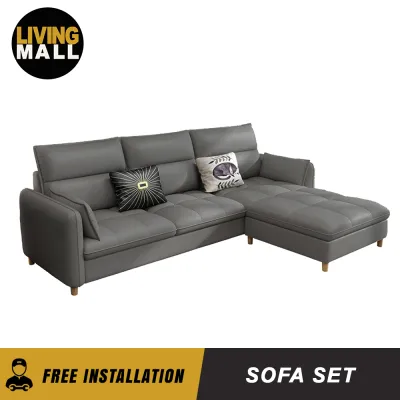
Prices are valid at publication and may change. Please refer to the product page for the latest price.
Leather grading is the most critical factor influencing both the price and the longevity of your L-shaped set. Full-grain leather represents the highest quality, retaining the natural hide’s original texture and breathability, which prevents the sticky feeling often associated with cheaper alternatives in warm weather. Top-grain leather is slightly more processed but offers excellent durability and a more uniform appearance. Corrected-grain leather features a buffed surface with a protective pigment layer, making it highly resistant to stains but less breathable. For households seeking budget-friendly or vegan alternatives, premium polyurethane or microfiber synthetic leathers offer easy maintenance but generally have a shorter lifespan than genuine hides.
Frame construction determines whether your sofa will sag or creak over years of daily use. High-quality brands utilize kiln-dried solid hardwoods, such as birch, oak, or beech, which have had their moisture content reduced to prevent warping in Singapore’s high relative humidity. Avoid brands that rely solely on low-grade engineered wood or unreinforced particle board for load-bearing components. The joints of the frame should be double-dowelled, glued, and reinforced with corner blocks to withstand the leverage forces exerted on the extended chaise section of an L-shaped configuration.
Suspension systems work in tandem with the frame to distribute weight evenly across the seating area. Sinuous springs, also known as no-sag springs, are the industry standard for providing a firm, supportive feel. Some premium brands employ pocketed coil springs within the cushions themselves, mimicking mattress construction to offer localized support and minimize motion transfer when multiple people sit together. Webbing suspension is also common, but it should be high-density and tightly woven to prevent premature sagging.
Cushion density dictates how well the sofa retains its shape after years of sitting. Look for high-resiliency polyurethane foam with a density rating of at least 30 kg/m³ to 35 kg/m³ for seat cushions. Lower-density foams compress quickly, leading to unsightly hollows and reduced comfort. Some brands wrap their foam cores in down feathers or polyester fiber to create a softer, loftier aesthetic, though these require regular fluffing to maintain their shape.
Space and Configuration Checks for Singapore Homes
An L-shaped sofa is an excellent tool for defining zones in open-plan living areas, but its substantial footprint requires precise spatial planning to avoid overcrowding your home.

Before visiting showrooms, map out your living room dimensions using painter’s tape on the floor to visualize the sofa’s physical boundaries. Ensure there is a minimum clearance of 60cm to 75cm around the chaise to allow for comfortable walkways and to prevent blocking access to balconies, corridors, or television consoles. If your living room features a compact rectangular layout typical of many modern apartments, a streamlined L-shaped set with slim armrests will maximize seating space without overwhelming the room visually.
Choosing the correct chaise orientation is vital for maintaining natural traffic flow. Stand facing the wall where the sofa will be placed to determine whether you need a left-arm-facing or right-arm-facing configuration. Placing the chaise on the wrong side can block natural light from windows, obstruct sliding balcony doors, or create awkward bottlenecks at the entrance of the room. If you anticipate moving homes in the future, consider brands that offer reversible or modular chaises that can be repositioned as needed.
Delivery logistics present a common bottleneck that buyers frequently overlook. Measure the clear width and height of your main entrance door, safety gate, and any tight corridor turns leading to your unit. Additionally, verify the interior dimensions and door clearance of your building’s passenger lift. Many L-shaped sofas are delivered in two or three separate modular sections to facilitate transport, but you must confirm these packaged box dimensions with the retailer beforehand to avoid costly failed delivery fees.
Brand Comparison Matrix: What to Verify Before Buying
When comparing different sofa retailers in Singapore, categorizing them by their brand profile helps clarify what you are paying for. Use the following matrix to guide your showroom visits and verify key specifications before making a purchase.
| Brand Profile | Leather Authenticity | Frame Construction | Customization Level | Key Verification Step |
|---|---|---|---|---|
| Premium Heritage | Full-grain or semi-aniline genuine leather | Kiln-dried solid hardwood | Low to moderate (fixed sizes, curated colors) | Request leather origin certificates and inspect stitching alignment in-store. |
| Value-Focused | Top-grain, corrected-grain, or high-grade synthetic | Engineered wood reinforced with solid timber | Moderate (standard sizes, popular color palettes) | Test cushion firmness in-store and verify the density of the foam used. |
| Modular Specialists | Top-grain leather or performance fabrics | Mixed hardwood and metal frames | High (configurable modules, reversible chaises) | Confirm the locking mechanism stability between modular units. |
Always request physical leather swatches to examine under natural light, as showroom spotlights can dramatically alter how colors appear. Touch the leather to assess its thickness and suppleness, and ask the sales representative for written confirmation of the frame materials and foam density ratings rather than relying on verbal assurances.
Decision Framework: Matching Brand Profiles to Your Priorities
To narrow down your choices, apply this conditional decision framework to match your household’s daily realities with the most suitable brand profile.
Choose a Premium Heritage Profile if:
- You view the sofa as a ten-year investment and appreciate the unique character and patina that genuine leather develops over time.
- Your living room is consistently air-conditioned or well-ventilated, minimizing the risk of humidity-related wear on natural hides.
- You prefer classic, structured designs and do not require frequent reconfigurations of your living space.
Choose a Value-Focused Profile if:
- Your household includes young children or active pets, making scratch resistance and easy spill cleanup your top priorities.
- You prefer a highly uniform leather appearance without natural skin markings or color variations.
- You want to maximize your seating capacity within a specific, modest budget.
Choose a Modular Specialist Profile if:
- You live in a rental property or plan to relocate, requiring furniture that can adapt to different room layouts.
- Your home has tight access points, such as narrow stairwells or small lift doors, where a standard one-piece sofa frame cannot pass.
- You enjoy rearranging your furniture periodically to refresh your interior design.
After-Sales Support and Long-Term Maintenance
A leather L-shaped sofa is a significant financial commitment, and protecting that investment requires understanding the retailer’s after-sales policies and establishing a consistent care routine.
Always distinguish between different tiers of warranty coverage. A reputable brand should offer a structural warranty of five to ten years covering the frame, joints, and suspension systems. Upholstery, stitching, and cushion fillings typically carry a shorter warranty of one to two years. Read the terms carefully to understand what constitutes manufacturing defects versus normal wear and tear, such as the natural stretching of leather over time.
Inquire whether the brand provides local repair, re-padding, or professional cleaning services. Having access to a dedicated local service team ensures that minor issues, such as a loose seam or a compressed cushion insert, can be resolved quickly without requiring you to replace the entire sofa set.
Maintaining leather in Singapore’s tropical climate requires balancing humidity control and moisture protection. Avoid placing your leather sofa in direct sunlight, which causes genuine hides to fade, dry out, and crack. Vacuum the crevices weekly using a soft brush attachment to remove dust and abrasive debris. Wipe the surface down fortnightly with a slightly damp microfiber cloth, and apply a specialized leather conditioner every six to twelve months to preserve the material’s natural oils and suppleness.
Frequently Asked Questions (FAQ)
Is genuine leather suitable for Singapore's humid climate?
Yes, genuine leather is highly suitable for local homes, provided it is properly maintained. High-quality genuine leather is naturally breathable, allowing it to dissipate body heat much more effectively than synthetic alternatives, which can feel sticky in warm weather. To prevent mold growth during periods of high humidity, ensure your living room remains well-ventilated or air-conditioned, and avoid placing the sofa in direct contact with damp walls.
Can I change the chaise orientation of an L-shape sofa after purchase?
Whether you can change the orientation depends entirely on the sofa’s design. Fixed L-shaped sofas are constructed with a permanent left- or right-facing chaise that cannot be altered after manufacturing. However, modular or reversible designs allow you to move the chaise section to either side by repositioning the underlying connectors or shifting a free-standing ottoman base. Always clarify this feature with the retailer before purchasing if you anticipate changing your room layout.
How do I verify if a sofa will fit through my HDB door and lift?
To ensure a successful delivery, measure the maximum height, width, and diagonal clearance of your HDB main door frame and metal gate. Next, measure the lift entrance width, interior cabin height, and depth. Compare these dimensions against the sofa’s packaged box dimensions, which you should request from the retailer. If your building requires navigating tight corridor corners or staircases, share photos and measurements with the brand’s delivery team beforehand to conduct a professional feasibility check.
Community discussion
Share your experience or ask a question. Comments are reviewed before publication.