
Finding a fabric reclining sofa that fits a Singapore Housing & Development Board (HDB) flat requires balancing comfort with strict spatial limits. While many international furniture brands design recliners for spacious suburban homes, several local and regional brands catering to the Singapore market offer compact, wall-hugging, or modular fabric reclining sofas engineered specifically for smaller living rooms. To find these models, you must look beyond standard retail displays and focus on brands that provide detailed dimensional schematics, zero-wall-clearance mechanisms, and customizable fabric configurations. By focusing on brands that prioritize space-saving engineering, you can enjoy the luxury of a recliner without compromising the flow and functionality of your home.
Understanding HDB Space Constraints for Reclining Sofas
Standard HDB living rooms, particularly in newer Build-To-Order (BTO) flats, present unique spatial challenges that make traditional, bulky reclining sofas impractical. Before browsing online stores or visiting showrooms, you must measure both the static footprint of the sofa and its dynamic footprint when fully extended. A standard sofa only occupies its designated floor area, but a recliner expands significantly, requiring additional clearance both in front for the footrest and behind for the backrest.
To calculate the required clearance, measure the distance from your living room wall to the edge of your television console or coffee table. A typical recliner needs anywhere from 130 cm to 180 cm of total depth when fully extended. If your living room width is only 3 meters, a fully reclined sofa can easily block the entire room, leaving virtually no space to walk past. You should aim to maintain a clear walking path of at least 60 to 75 cm between the extended footrest and any opposite furniture to ensure safe and comfortable traffic flow.
Products mentioned in this guide
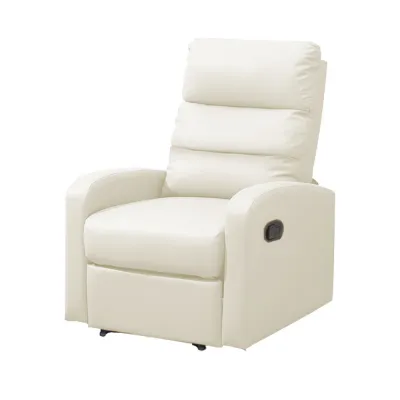
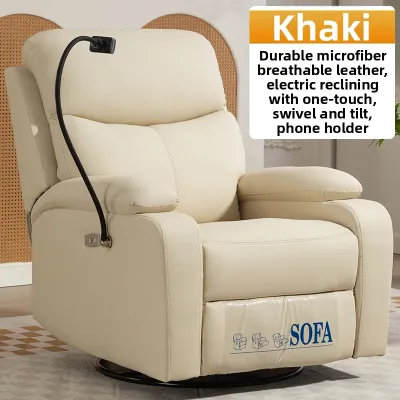
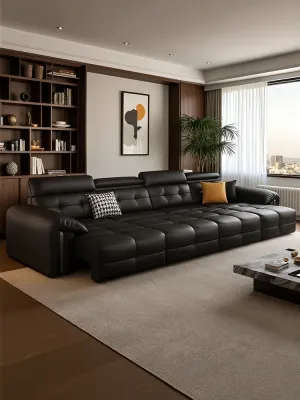
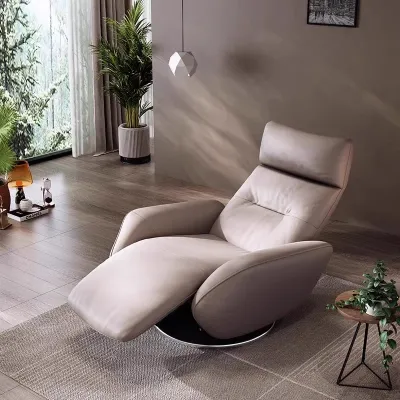
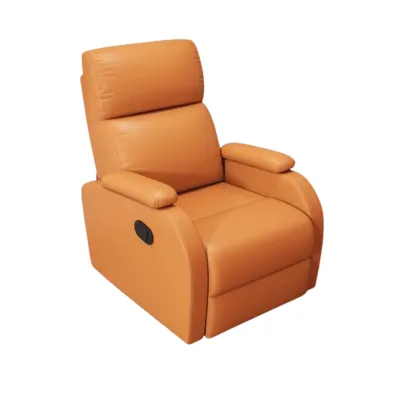
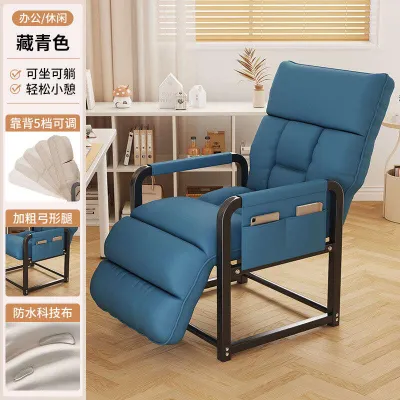
Prices are valid at publication and may change. Please refer to the product page for the latest price.
Another critical layout factor is the placement of adjacent furniture and architectural features. If you plan to place a coffee table in front of the sofa, it must be lightweight or set on casters so it can be easily pushed aside when you want to recline. Additionally, you must account for side clearance if the sofa is placed near a doorway, hallway, or window.
In many HDB layouts, the household shelter (bomb shelter) is located near the entryway or directly along the main living room wall. The heavy steel door of the household shelter swings outward and requires completely unobstructed clearance to comply with safety regulations. If your reclining sofa is positioned too close to this door, even a partially extended footrest or a wide armrest can block the door’s path. Always measure the exact swing radius of the shelter door and ensure your sofa placement leaves a generous buffer zone.
Key Dimensions and Design Features for Compact Spaces
When searching for a fabric recliner suitable for an HDB flat, specific design features and mechanical configurations can make a massive difference in how well the piece fits your space. The overall width of the sofa is the first constraint to consider. For a standard HDB living room wall, a compact two-seater reclining sofa should ideally measure between 140 cm and 160 cm in width, while a compact three-seater should stay within 180 cm to 210 cm.

The most important mechanical feature to look for is a zero-wall-clearance, or “wall-hugger,” mechanism. Traditional recliners require 30 cm to 50 cm of space behind the backrest to tilt backward, which forces the entire sofa away from the wall and wastes valuable floor space. In contrast, a wall-hugger recliner is engineered to slide the seat forward as the backrest reclines. This allows you to position the sofa as close as 5 cm to 10 cm from the wall, maximizing your usable living room area.
Visual weight also plays a significant role in how spacious your living room feels. Traditional recliners often feature heavy, block-like bases that sit flat on the floor, creating a cramped visual effect. To counter this, look for brands that offer high-leg or raised-base reclining designs. Sofas with legs that elevate the base at least 10 cm to 15 cm off the ground allow light to pass underneath, creating the illusion of more space while making it much easier to clean the floor underneath, whether manually or with a robot vacuum.
Furthermore, modular configurations offer far more flexibility than fixed two-seater or three-seater options. A modular fabric reclining sofa allows you to customize which sections actually recline. For instance, you can choose a three-seater configuration where only one end seat reclines, leaving the middle and opposite seats stationary. This prevents the sofa from blocking walkways on both sides and allows you to tailor the reclining function to the specific side of the room with the most clearance.
How to Identify Brands with HDB-Suitable Fabric Recliners
Identifying brands that genuinely cater to HDB living spaces requires a systematic approach, as many retailers display oversized models that look deceptively small in spacious showrooms. Start by searching for brands that feature dedicated “compact,” “apartment-size,” or “space-saving” collections on their websites. These collections are specifically curated for smaller footprints and often feature narrower armrests, which can save up to 20 cm of overall width without reducing the actual seating area.
Never rely solely on visual proportions in product photos or showroom displays. Showrooms typically have high ceilings and open layouts that make large furniture appear compact. Always request the official specification sheet or product manual from the retailer. This document should list the precise dimensions, including the depth when fully reclined, the height of the seat, the width of the armrests, and the exact wall clearance required for operation. If a brand cannot provide these measurements, it is best to look elsewhere.
Fabric selection is another crucial step when choosing a recliner for Singapore’s warm and humid climate. While leather is often associated with recliners, fabric offers superior breathability and comfort in non-air-conditioned spaces. However, fabric is more susceptible to spills and stains. Look for brands that offer performance fabrics, such as those treated with water-resistant or stain-resistant coatings. Check the fabric’s Martindale rating, which measures durability; a rating of 20,000 rubs or higher is recommended for high-traffic household furniture.
Additionally, verify if the brand offers customization options for their reclining models. Some specialized retailers allow you to choose from different armrest widths, select modular configurations, or even adjust the seat depth. Choosing a brand that offers these bespoke adjustments ensures that you do not have to compromise on comfort or sacrifice precious walking space in your HDB flat.
Delivery, Assembly, and Pre-Purchase Verification
Even if a fabric reclining sofa fits perfectly within your living room layout, it must first survive the journey from the delivery truck to your flat. HDB corridors, lift lobbies, and doorways present strict physical bottlenecks that can lead to costly delivery failures. Before finalizing your purchase, you must conduct a thorough logistical audit of your building’s entry points.
Start by measuring the width and height of your HDB lift doors, as well as the interior depth and height of the lift cabin. Next, measure the width of the corridor outside your flat, paying close attention to any tight corners or turning angles where a long sofa box could get stuck. Finally, measure the clear opening width of your main door and safety gate. Reclining sofas are inherently heavier and bulkier than standard sofas due to their internal metal mechanisms, making them much harder to maneuver around tight corners.
To mitigate these delivery risks, confirm how the sofa is packaged and shipped. Many high-quality reclining sofas are designed to be delivered in multiple boxes or with detachable backrests. This modular packaging allows delivery teams to carry the components through narrow doorways and assemble the sofa directly in your living room. Always ask the retailer if their delivery service includes professional on-site assembly and if they test the reclining mechanism before leaving.
Lastly, carefully review the brand’s return, exchange, and cancellation policies. If a sofa cannot physically fit through your doorway or lift, some retailers charge substantial restocking fees, which can range from 15% to 30% of the purchase price, or they may refuse returns entirely. Ensure you understand who bears the financial responsibility for a failed delivery due to spatial constraints, and only purchase from brands that offer clear, fair terms for returns and exchanges.
Frequently Asked Questions (FAQ)
Can a reclining sofa block the HDB household shelter door?
Yes, if placed incorrectly, a reclining sofa can easily block or restrict the opening of your HDB household shelter door. The heavy steel door of the shelter must be able to open fully to its maximum angle at all times to ensure safety and compliance with local building regulations. If your living room layout forces you to place the sofa along the same wall as the shelter, you must ensure that neither the armrest nor the fully extended footrest encroaches on the door’s swing path. If space is extremely limited, consider placing the sofa on the opposite wall, or choose a modular recliner where the reclining mechanism is positioned on the side furthest from the shelter door.
Are manual or motorized recliners better for HDB power outlet layouts?
The choice between manual and motorized recliners largely depends on your flat’s electrical layout and your tolerance for visible cables. Motorized recliners offer smooth, incremental adjustments at the touch of a button, but they require a continuous power source. In many HDB flats, power outlets are fixed along some walls, and running extension cords across the living room floor creates a serious trip hazard and looks untidy. If your sofa will be placed far from an outlet, a manual recliner—which operates via a physical latch, pull-tab, or body tension—is a highly practical, cord-free alternative. Alternatively, some brands offer motorized models with rechargeable lithium-ion battery packs, allowing you to enjoy motorized convenience without trailing wires across your floor.

Community discussion
Share your experience or ask a question. Comments are reviewed before publication.