
Finding the right furniture for a Singapore Housing & Development Board (HDB) flat requires a careful balance of spatial efficiency and daily comfort. When selecting a floor sofa bed, the ideal size depends heavily on your specific flat type and the layout of your living room. For smaller 3-room and 4-room flats, a single or super single floor sofa bed (ranging from 90 cm to 110 cm in width) provides flexible seating without blocking vital walkways. In more spacious 5-room and Executive flats, a double or queen-size model (measuring 120 cm to 150 cm in width) can serve as a substantial centerpiece while easily transforming into a guest bed.
To ensure your floor sofa bed integrates seamlessly into your home, you must look beyond total floor area. You need to account for the physical footprint in both folded and unfolded states, leaving adequate clearance for movement, and selecting materials suited for floor-level living in a tropical climate.
Assessing Your HDB Living Room Layout and Usable Space
Before browsing designs, you must distinguish between the gross floor area listed on your HDB floor plan and the actual usable floor space in your living room. High-traffic walkways, the placement of dining furniture, and access routes to bedrooms or the kitchen significantly reduce the area where a floor sofa bed can sit. A common mistake is measuring only the empty wall space and forgetting that a living room must remain walkable when the bed is fully extended.
Products mentioned in this guide
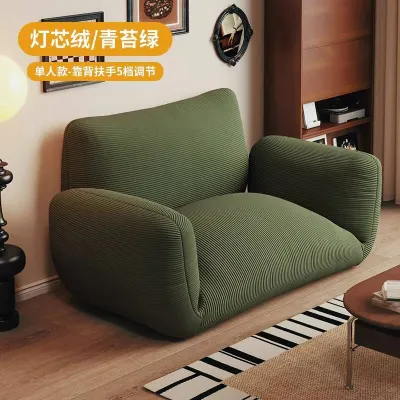
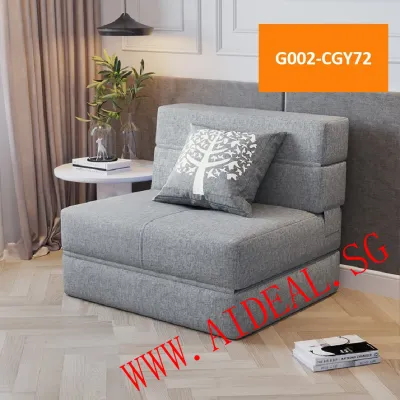

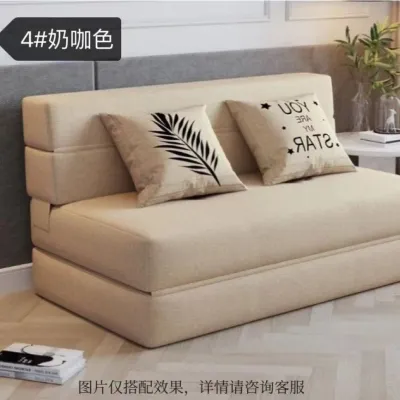
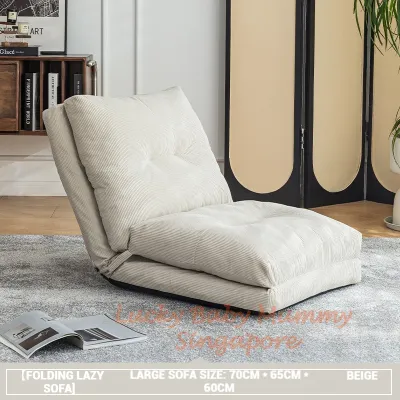
![[Free installation] Electric Recliner Sofa Chair | Single Zero Gravity Motorized Lounge Chair | Rotating Lazy Sofa Bed with Warranty](https://img.lazcdn.com/g/p/76a9b5a7220bfea1b826a65095b7fbbc.jpg_400x400q80.jpg_.webp)
Prices are valid at publication and may change. Please refer to the product page for the latest price.
The layout style of your HDB flat also dictates how you should position low-profile furniture. Modern BTO flats often feature open-concept living and dining areas, which offer greater layout flexibility but lack solid walls to anchor large furniture pieces. Conversely, older, segmented HDB layouts have distinct walls but may restrict where you can place a folding unit without blocking access doors or the household shelter.
To determine the right size, define the primary function of the floor sofa bed in your daily life. If it serves mainly as a cozy reading nook or a secondary seat for daily television viewing, a compact footprint is preferable. If its primary purpose is to accommodate overnight guests frequently, you will need to allocate a larger permanent footprint, ensuring that the surrounding space can be easily cleared when it is time to unfold the mechanism.
Finally, never overlook the journey from the delivery truck to your living room. Before finalizing any purchase, verify the dimensions of your HDB block’s passenger lift, main door frame, and any narrow corridors inside your flat. Low-profile floor sofa beds are often delivered as single, bulky packages that do not disassemble easily, making lift and entryway clearance a critical first step.
Recommended Floor Sofa Bed Sizes by HDB Flat Type
Floor sofa beds generally align with standard Singapore mattress widths, but their total footprint can vary based on the thickness of the cushions, the folding mechanism, and the presence of built-in armrests. When shopping, always check the manufacturer’s exact specification sheet rather than relying solely on generic size labels like “double” or “queen.”

Compact Fits for 3-Room and 4-Room Flats
For 3-room and 4-room HDB flats, where living room widths often range between 3 and 3.5 meters, preserving open floor space is essential to prevent a cramped atmosphere. A single (approximately 90 cm wide) or super single (approximately 107 cm wide) floor sofa bed is highly recommended for these layouts. These compact dimensions allow the piece to function as a comfortable two-seater sofa during the day while occupying minimal floor space.
When placing a compact floor sofa bed in a smaller living room, positioning it against a solid wall is usually the most efficient choice. This arrangement keeps the center of the room open for low coffee tables, footstools, or daily foot traffic. It also ensures that when you unfold the unit into sleeping mode, the extension projects outward into the open living area rather than blocking the main pathway to the kitchen or bedrooms.
Maintaining clear pathways is not just a matter of convenience; it is also a safety requirement. Ensure that even when the floor sofa bed is fully extended, there is still an unobstructed path of at least 60 cm to 75 cm to allow household members to move around the room safely, especially in low-light conditions at night.
Spacious Options for 5-Room and Executive Flats
In larger 5-room flats and Executive Apartments (EAs) or Executive Maisonettes (EMs), the living area is often spacious enough to accommodate double (approximately 135 cm wide) or queen-size (approximately 150 cm wide) floor sofa beds. These larger sizes provide generous seating for three to four adults and offer a comfortable, unrestricted sleeping surface for couples or multiple guests.
In these larger, open-plan layouts, a low-profile floor sofa bed can be used strategically to anchor the seating zone. Instead of pushing the furniture against a wall, you can position a queen-size floor sofa bed in a semi-central location, keeping it clear of windows and balcony sliding doors to preserve natural light and ventilation. This placement helps maintain clear sightlines across the room, making the space feel airy and expansive.
To define the seating area visually in a larger room, consider placing a large area rug beneath the floor sofa bed. The rug acts as a visual boundary, separating the lounge zone from the dining area or study nook. Ensure the rug is slightly wider than the fully extended sofa bed to prevent the edges from curling or creating a tripping hazard when the bed is in use.
How to Measure Clearance for Seating and Sleeping Modes
To ensure your floor sofa bed is fully functional, you must measure your living space using a systematic, step-by-step approach that accounts for both the folded and unfolded configurations.
First, measure the folded footprint of the unit. This includes the maximum width from outer edge to outer edge, and the folded depth from the backrest to the front cushion. Mark this area on your living room floor using masking tape to visualize how much physical space the sofa will occupy during the day. Ensure that this taped zone does not overlap with door swings, cabinet doors, or the path of sliding balcony panels.
Second, calculate the unfolded clearance. Locate the manufacturer’s specification for the fully extended length of the bed, which typically ranges from 180 cm to 210 cm. Extend your masking tape on the floor to reflect this full length. Beyond the foot of the bed, you must maintain a buffer zone of at least 60 cm to 90 cm. This buffer is crucial for walking around the bed, accessing nearby light switches, and allowing space to make the bed with sheets and blankets without feeling pinned against the wall.
Third, check for vertical and wall-mounted obstructions. Because floor sofa beds sit directly on the ground, their backrests often tilt backward during the unfolding process. Measure the distance between the back of the sofa frame and the wall to ensure the reclining mechanism has enough clearance to operate without scraping your paint or wallpaper. Additionally, verify that the height of the backrest does not block low windowsills, wall-mounted television screens, air conditioning units, or electrical outlets that you need to access daily.
Choosing Fabric and Low-Profile Designs to Maximize Space
The visual weight of your furniture plays a significant role in how spacious your HDB living room feels. Low-profile, legless floor sofa beds are excellent for compact spaces because their low height keeps the sightline open, making your ceilings appear higher. However, because they sit directly on the floor, they can look bulky if you do not choose the right fabric, color, and texture.
When selecting materials, prioritize durable, tightly woven fabrics that are easy to clean. Because floor-level furniture is closer to the ground, it is naturally more exposed to floor dust, pet dander, and accidental spills. Look for fabric treatments on the product label that offer stain resistance or removable, machine-washable covers. Tightly woven synthetic blends, such as polyester or nylon weaves, generally offer better wear resistance and are easier to vacuum than loose, delicate knits.
Color selection is equally important for managing visual space. Lighter fabric tones—such as beige, light gray, soft cream, or pastel hues—reflect more light, helping a large furniture piece blend into the background rather than dominating the room. If you prefer darker colors for practical reasons, look for subtle textured weaves, such as a heathered gray or a soft herringbone pattern, which add depth without making the sofa bed look like a heavy, solid block in the middle of your living room.
Common Sizing and Placement Mistakes to Avoid
Avoiding common pitfalls during the planning and purchasing stages will save you from spatial frustration and premature wear on your furniture.
One of the most frequent mistakes is assuming that the labeled “sofa size” corresponds perfectly to standard bed dimensions. Many buyers purchase a “double” floor sofa bed assuming it will fit a tight space, only to find that the wide, padded armrests or the thick folding frame add an extra 15 cm to 20 cm to the overall width. Always base your layout planning on the outer finished dimensions provided in the manufacturer’s specifications, rather than the nominal mattress size.
Another critical error is placing the floor sofa bed too close to balcony sliding doors or low-level windows. In Singapore’s tropical climate, open balconies are essential for natural ventilation. Blocking these areas with a fully extended bed restricts airflow, reduces natural light, and can impede emergency egress routes. Keep a clear clearance zone of at least 1 meter from any balcony entrance or main exit point.
Finally, because floor sofa beds rest directly on the floor, they are highly susceptible to moisture traps. In humid climates, moisture can accumulate between the bottom of the mattress and the flooring, creating an ideal environment for mold and mildew. To prevent this, check the manufacturer’s care instructions. It is highly recommended to lift the sofa bed, vacuum underneath, and air out the cushions regularly. Choosing a model with a breathable bottom liner or placing a thin, breathable non-slip pad underneath can also help protect both your flooring and your sofa bed from moisture damage.

Community discussion
Share your experience or ask a question. Comments are reviewed before publication.