
A 3-seater recliner sofa represents a luxurious way to unwind at home, but if you live in a Housing & Development Board (HDB) flat in Singapore, you might wonder if such a substantial piece of furniture can realistically fit into your living room. Yes, a recliner sofa 3 seater can absolutely fit into an HDB living room, but success depends entirely on precise space planning and choosing the right design.
In compact modern homes, particularly newer Build-To-Order (BTO) flats, space is at a premium. A standard 3-seater recliner requires careful layout consideration because it occupies a much larger footprint than a traditional stationary sofa. By understanding your flat’s spatial constraints, measuring the full motion path of the reclining mechanism, and selecting a model tailored to your layout, you can enjoy premium comfort without making your living room feel cramped or visually overwhelming.
Understanding the Dimensions: 3-Seater Recliners vs. HDB Living Rooms
When shopping for a recliner sofa 3 seater, it is easy to make the mistake of assuming all models share similar dimensions. In reality, ‘3-seater’ is simply a capacity label; the physical footprint of these sofas varies drastically based on their design, armrest style, and upholstery material. For instance, a sleek, modern fabric recliner sofa with slim track arms might have an overall width of 2.0 to 2.2 meters. Conversely, a traditional, heavily padded model with plush pillow-top armrests can easily stretch to 2.4 meters or wider, even though both accommodate the same number of people.
Products mentioned in this guide
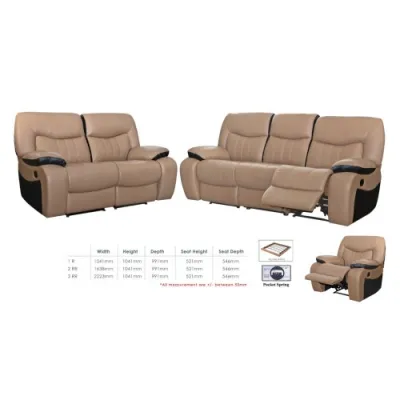
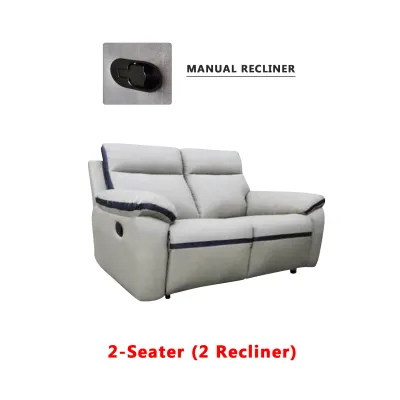
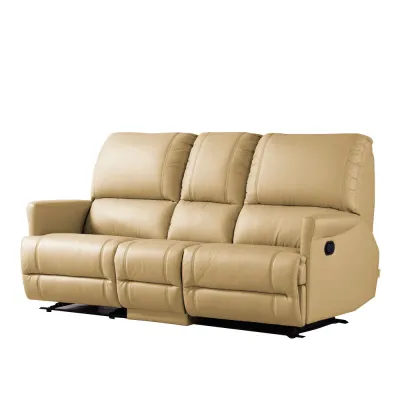
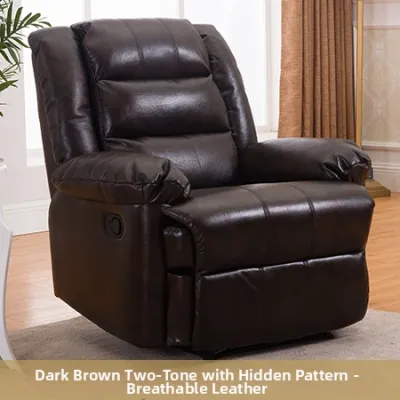
![[Free Installation] Univonna Javier 3-Seater Recliner Sofa | Modern PU Leather Sofa | Comfortable Manual Recline | Custom Colors & Free Delivery](https://img.lazcdn.com/g/p/efc6050842ae33687b515884fae613f5.jpg_400x400q80.jpg_.webp)
Prices are valid at publication and may change. Please refer to the product page for the latest price.
The spatial reality of Singapore’s HDB living rooms has evolved significantly over the decades. If you reside in an older resale flat built in the 1980s or 1990s, you likely enjoy a generous living area with a wall-to-wall width of 3.6 meters or more. However, if you are moving into a newer BTO flat, your living room width—the distance from the main sofa wall to the opposite TV feature wall—is likely closer to 3.0 to 3.3 meters.
This distance is the most critical dimension in your space planning. In a standard BTO layout, you must account for the depth of the sofa, the depth of your TV console, and the remaining walkway. If your living room width is 3.0 meters, placing a standard 1.0-meter-deep sofa on one side and a 45cm-deep TV console on the other leaves you with just 1.55 meters of central space. Because a 3-seater recliner needs to extend forward when deployed, a model that stretches to 1.6 meters when fully reclined will physically collide with your console or block the entire room.
To prevent these issues, you must rely strictly on the manufacturer’s detailed dimension chart for the exact model you are considering. Look for specific measurements representing the sofa’s depth when upright, its maximum depth when fully reclined, and its overall width. Never rely on generic online size guides, as even a few centimeters of discrepancy can disrupt your entire living room layout.
How to Measure Your Space for a Recliner Sofa
Measuring the Footprint and Recline Clearance
To ensure your recliner sofa 3 seater fits your designated floor area and functions smoothly, you must measure its footprint in three distinct states: upright, fully reclined, and the transition phase. Start by using masking tape to outline the upright dimensions of the sofa on your living room floor. This simple step provides a clear visual representation of how much physical space the sofa will occupy during daily use.

Next, you must calculate the ‘wall clearance’ or ‘pitch back’ requirement. Traditional recliners operate by tilting the backrest backward, which means the entire frame must be positioned 30cm to 50cm away from the wall to function. In a compact HDB living room, leaving a half-meter gap behind your sofa is highly inefficient and significantly reduces your remaining walkway.
To maximize your floor space, look for ‘zero-wall-clearance’ or ‘wall-hugger’ models. These innovative designs utilize a forward-sliding mechanism. As you recline, the seat slides forward while the backrest moves downward, requiring as little as 5cm to 10cm of clearance from the wall. This allows you to push the sofa almost completely flush against your living room wall, saving valuable space.
Finally, do not forget to check for local architectural obstructions. Walk around your taped-out area and look for skirting boards, which can prevent a wall-hugger sofa from sitting flush. Check for protruding electrical sockets, light switches, window sills, or low-hanging curtains. If the backrest of your recliner rubs against a rough wall surface or a window sill every time it opens, the fabric can wear out prematurely, or the reclining motor may experience unnecessary strain.
Checking the Delivery Path
A common and frustrating mistake is purchasing a beautiful 3-seater recliner only to discover it cannot fit through your building’s entryways. Because recliners contain heavy metal frames and motorized components, they are often significantly heavier and less flexible than standard sofas, making delivery logistics a critical step.
Start by measuring the access points along the delivery route. Measure the height and width of your HDB lift doors, as well as the interior cabin’s height, width, and diagonal depth. Keep in mind that older HDB estates may have smaller passenger lifts compared to newer BTO developments. Next, measure the width of the common corridor outside your unit, pay attention to any tight corners, and measure your main metal gate and wooden entrance door.
Always ask your furniture retailer for the packaging dimensions of the sofa. Fortunately, many modern 3-seater recliners are designed with logistics in mind. They are often delivered in modular, individual seat sections or feature detachable backrests that can be clicked into place after delivery. Confirming these details with your retailer beforehand ensures a smooth delivery process and prevents the disappointment of a rejected delivery.
Layout Strategies to Maximize HDB Living Room Space
Accommodating a recliner sofa 3 seater in a compact HDB flat requires strategic interior design choices. The most common layout is placing the sofa directly against the longest wall, facing the TV console. This arrangement keeps the center of the room open, which is essential for maintaining a spacious feel. If you choose this layout, a wall-hugger recliner is highly recommended to avoid wasting space behind the sofa.
If you live in a larger resale flat or have an open-concept BTO layout, you might consider ‘floating’ the sofa in the middle of the room to act as a natural divider between the living and dining areas. While this creates a modern, zoning effect, it requires a minimum of 80cm to 90cm of clear walkway behind the sofa. In smaller flats, this layout can quickly make the room feel cramped and restrict movement.
To keep your living room functional when the footrests are fully extended, you must rethink your coffee table choice. A traditional, heavy rectangular wooden coffee table will block the recliner’s movement and leave no room for walkways. Instead, opt for space-saving alternatives. Nesting tables are an excellent choice because they can be stacked away when you want to recline and pulled out when needed. Alternatively, slim, C-shaped side tables that slide over the armrests of your sofa provide a convenient surface for drinks and remotes without taking up floor space.
Traffic flow is another vital consideration. Ensure that even when all three seats of your recliner are fully deployed, a clear walkway of at least 60cm remains open. This prevents family members from having to awkwardly step over extended footrests or squeeze past the sofa to reach the kitchen or bedrooms.
Finally, consider the visual weight of your furniture. Fabric sofas in lighter, neutral tones—such as beige, light grey, cream, or soft pastel shades—are highly effective at making a compact room feel larger. Dark, bulky leather sofas tend to absorb light and dominate a space visually, making a small HDB living room feel enclosed. Textured fabrics, on the other hand, bounce light and introduce a soft, cozy aesthetic that complements modern Singaporean interior design.
Alternative Solutions If a Standard 3-Seater Won't Fit
If your measurements reveal that a standard 3-seater recliner sofa is simply too large for your HDB living room, you do not have to give up on your dream of comfortable lounging. There are several highly practical alternative solutions that offer the same level of relaxation with a much smarter footprint.
One popular alternative is choosing a 2-seater recliner sofa and pairing it with a matching fabric ottoman or a separate single recliner chair. A 2-seater model is significantly narrower, often saving 50cm to 70cm of wall space compared to a 3-seater. The addition of a mobile fabric ottoman provides a comfortable footrest for a third person when needed, and it can easily be tucked away in a corner or used as extra seating when guests visit.
Another versatile option is a modular recliner sofa. Modular systems allow you to customize the configuration of your seating. For example, you can purchase a 3-seater frame where only the two outer seats feature reclining mechanisms, while the middle seat remains stationary. This design reduces the overall mechanical weight and power requirements of the sofa. Additionally, modular pieces can be separated and rearranged easily, providing long-term flexibility if you decide to move or renovate.
You can also explore semi-customizable fabric sofas offered by local furniture retailers. While the internal metal reclining mechanisms are standard sizes, some manufacturers allow you to customize the outer frame. By selecting a model with ultra-slim armrests, you can significantly reduce the overall width of the sofa without sacrificing the actual width of the seats. Shaving just 10cm off each armrest can make the difference between a sofa that fits perfectly and one that blocks your doorway.
Common Space Planning Mistakes to Avoid
To ensure a stress-free purchasing experience, keep these common space planning pitfalls in mind:
- Measuring only the upright depth: Always check the fully extended length of the sofa to ensure it fits your room when in use.
- Ignoring the TV console depth: Subtract the depth of your TV console and any wall-mounted units from your total room width before calculating your remaining walkway.
- Assuming standard sizing: Never assume all 3-seater sofas share the same dimensions. Always verify the exact specifications of each model.
- Neglecting power source access: Electric recliners must be plugged in. Ensure the power cord can reach your HDB wall socket safely without stretching across walkways, which creates a dangerous tripping hazard.
- Overlooking safety clearances: If you have young children or pets, ensure there is enough clearance around the moving metal parts of the reclining mechanism to prevent accidental pinching or injury during operation.
Frequently Asked Questions (FAQ)
Do I need to install a new power point for an electric recliner in my HDB?
You do not strictly need to install a new power point, but you must plan your layout around your existing electrical sockets. Check the length of your recliner’s power cord against the nearest HDB wall socket. Running long extension cords across active walkways is highly discouraged as it creates a severe tripping hazard. If your desired layout places the sofa far from an outlet, it is highly recommended to consult a licensed electrician to install a safe, low-profile wall socket nearby.
Will a thick rug interfere with the recliner mechanism?
Yes, high-pile or thick shaggy rugs can easily obstruct the moving metal parts of a recliner’s footrest or bottom frame. This obstruction can strain the motor of an electric recliner or prevent a manual mechanism from locking properly. To avoid mechanical damage, ensure the sofa’s feet rest firmly on the hard floor, or choose a low-pile, flat-weave rug that sits well clear of the footrest’s path of motion.
Community discussion
Share your experience or ask a question. Comments are reviewed before publication.