
Quick Guide to Mirror Wardrobes for HDB Bedrooms
Optimising space in a Singapore Housing & Development Board (HDB) flat requires strategic furniture choices. When dealing with the compact footprints of modern Build-To-Order (BTO) master bedrooms—which typically range from 9 to 12 square metres—or even smaller common bedrooms of 7 to 9 square metres, every square centimetre counts. A wardrobe with mirror panels is one of the most effective dual-purpose installations you can choose, serving as a high-capacity storage hub while visually doubling the perceived boundaries of the room.
Finding the right mirrored wardrobe involves choosing between mass-market modular brands and local custom built-in carpentry. Modular wardrobes offer immediate availability, predictable pricing, and flexible configurations that you can adjust over time. Conversely, custom built-in designs allow you to utilise awkward structural columns, uneven alcoves, and the full floor-to-ceiling height of your bedroom. Integrating a mirror directly onto the wardrobe doors reflects natural light from windows, brightens dark corners, and eliminates the need for a standalone dressing mirror that would otherwise consume valuable floor space.
This guide outlines the essential spatial clearances, safety standards, and structural realities of installing mirrored wardrobes in Singapore. By understanding how different door mechanisms and brand offerings align with typical HDB layouts, you can make an informed investment that enhances both the storage capacity and the visual flow of your home.
Products mentioned in this guide
![[INNDESIGN.SG] Rey 3 Doors Wardrobe + Mirror + Drawer (Fully Assembled and Free Delivery)](https://img.lazcdn.com/g/p/5d53f103a5e2f003c5c6c97e2fbd2a21.jpg_400x400q80.jpg_.webp)
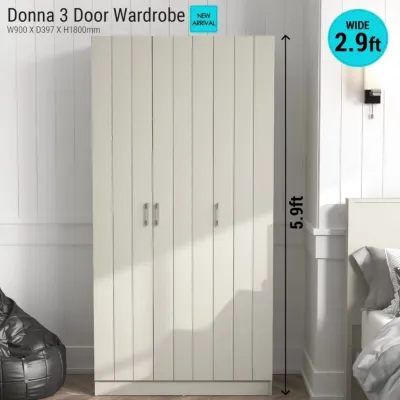
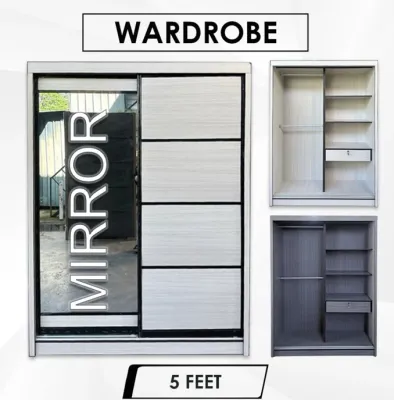
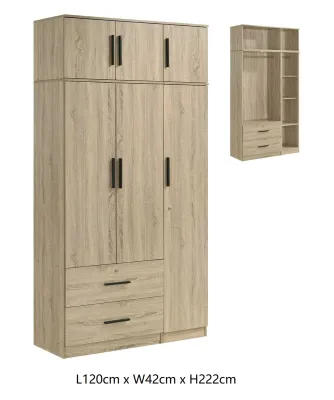
Prices are valid at publication and may change. Please refer to the product page for the latest price.
What Makes a Wardrobe Ideal for Small HDB Bedrooms?
Selecting a wardrobe for a compact bedroom requires a careful evaluation of dimensions, door mechanics, and material safety. A poorly planned installation can restrict movement, block walkways, or create a claustrophobic environment. To avoid these issues, look for specific design characteristics that align with small-space living.

Door Mechanisms and Walkway Clearances
The choice between sliding and hinged doors dictates how much physical space you must preserve around the wardrobe. Sliding doors operate on top and bottom tracks, requiring zero clearance in front of the wardrobe to open. This makes them highly suitable for narrow bedrooms where the bed frame sits close to the wardrobe facade.
Hinged doors require a clear swing radius, typically demanding at least 500mm to 600mm of unobstructed space in front of the wardrobe. If you select hinged doors, you must also factor in standing room for yourself while the door is fully open. In a standard 3-metre-wide HDB bedroom, a standard queen-size bed (152cm wide by 190cm long) placed opposite a 600mm-deep wardrobe leaves less than 900mm of total walkway clearance. In such tight configurations, sliding doors are almost always the more practical choice.
Mirror Integration and Visual Weight
How the mirror is integrated into the wardrobe design significantly alters the room’s visual weight. Full-length external mirrored doors reflect the entire bedroom, effectively erasing the visual presence of a large, bulky cabinet. This reflection tricks the eye into perceiving a continuous space, which is highly beneficial in rooms with limited natural light.
If you prefer a cleaner, more minimalist wood or laminate exterior, internal pull-out mirrors or door-mounted inner mirrors are excellent alternatives. These mirrors remain hidden behind the wardrobe doors when not in use, preserving a uniform facade while still providing a full-length reflection when needed. However, internal mirrors do not contribute to the constant reflection of light and space that external mirrors provide.
Depth, Proportions, and Layout Planning
Standard wardrobes feature an external depth of approximately 600mm, which accommodates standard clothes hangers placed perpendicular to the doors. If your bedroom walkway is exceptionally narrow, consider slim-depth wardrobes measuring 400mm to 450mm deep. These space-saving designs require pull-out hanging rails where clothes hang parallel to the doors. While this reduces total hanging capacity, it reclaims valuable floor space and prevents the wardrobe from protruding past doorways or window frames.
Safety and Material Specifications
Because mirrors are made of glass, safety is a primary concern in high-traffic, compact bedrooms where accidental bumps are common. Ensure that any mirrored wardrobe door you purchase features safety-backed glass. This typically involves a shatterproof adhesive film applied to the rear of the mirror. If the glass breaks, the film holds the shards in place, preventing sharp pieces from scattering across the floor.
For homes with active children or pets, lightweight acrylic mirrors are a durable, impact-resistant alternative to traditional glass. While acrylic mirrors are virtually shatterproof, they are more susceptible to surface scratching and can exhibit minor visual distortion over large, unsupported surfaces. If choosing glass, opt for tempered glass mirrors or high-quality silver-backed float glass with polished edges to ensure both safety and optical clarity.
Leading Wardrobe Brands in Singapore for Mirror Designs
Singapore’s furniture market offers a diverse range of wardrobe solutions, categorised broadly into mass-market modular systems and premium freestanding or custom-built options. Understanding what each category offers helps you align your purchase with your budget, timeline, and spatial constraints.
Mass-Market and Modular Options
For homeowners seeking cost-effective, readily available storage, mass-market brands provide highly functional modular systems with integrated mirror options. These brands are ideal if you need a quick storage solution or are renting and want furniture that can potentially be disassembled and moved.
- IKEA: The Swedish retailer's PAX wardrobe system is a staple in Singaporean homes due to its immense customisability. Homeowners can pair PAX frames with sliding door options like the AULI glass mirror panels. IKEA offers these systems in two heights (201cm and 236cm) and two depths (35cm and 58cm), allowing you to tailor the wardrobe to your ceiling height and walkway limits. The primary advantage of the PAX system is the ability to design your own internal configuration with drawers, pull-out trays, and lighting. However, because these are standard sizes, they will rarely fit wall-to-wall or floor-to-ceiling perfectly, leaving small gaps where dust can accumulate.
- FortyTwo: As one of Singapore's largest local online furniture retailers, FortyTwo offers a wide array of budget-friendly, pre-configured sliding wardrobes featuring integrated mirror panels. Many of their designs are specifically tailored to typical HDB bedroom heights and aesthetics, featuring neutral laminates and space-saving sliding tracks. These wardrobes are highly economical, often ranging from S$300 to S$800, and typically include delivery and installation. The trade-off is limited internal customisation compared to modular systems like PAX, and the materials used are often lower-density particleboards that require careful handling in humid environments.
Premium Freestanding and Custom Built-Ins
If you have a larger budget and want to maximise every single millimetre of your HDB bedroom, premium freestanding brands or local custom carpentry specialists offer superior fit, finish, and durability.
- Castlery and Commune: These premium local design brands offer beautifully crafted freestanding wardrobes that often incorporate mirror accents, integrated dressing tables, or high-end wood veneers. While these pieces serve as stunning design statements, they are freestanding units with fixed dimensions. They are best suited for larger HDB master bedrooms where wall-to-wall integration is not strictly necessary to save space.
- Local Custom Carpentry and Interior Specialists: For a truly seamless look, engaging a local carpenter or interior design firm to build a custom wardrobe is the gold standard. Custom built-ins can be constructed to the exact millimetre, running fully from floor to ceiling (typically 2.8 metres in HDB flats) and wall to wall. This eliminates dust-gathering gaps and allows you to build around structural columns or ceiling beams seamlessly. You can specify full-length mirrored sliding doors with high-quality aluminium frames and soft-close dampening systems. Custom built-ins generally cost between S$200 to S$350 per foot run, meaning a standard 6-foot wardrobe can cost S$1,200 to S$2,100 or more, depending on the complexity of the internal fittings and the quality of the laminates. They also have longer lead times (typically 3 to 6 weeks for fabrication) and cannot be moved once installed.
Sliding vs. Hinged Doors: Which Mirror Wardrobe Fits Your Room?
Deciding between sliding and hinged doors is not merely an aesthetic choice; it directly impacts how you interact with your bedroom space daily. Both systems have distinct advantages and operational trade-offs that you must consider.
Spatial Analysis and Layout Planning
Sliding doors are the undisputed champions of small-space efficiency. Because the doors glide horizontally within the wardrobe’s frame, you can place other furniture—such as a bedside table, a study desk, or even the bed itself—just centimetres away from the wardrobe without restricting access to your clothes. This allows for highly compact room layouts that would be impossible with hinged doors.
Hinged doors, however, offer a distinct functional advantage: they allow you to open the entire wardrobe simultaneously. This makes organizing, cleaning, and selecting outfits much easier, as you can view your entire wardrobe contents at a single glance. If your HDB bedroom has a wider layout where the bed is positioned far from the wardrobe wall, hinged doors provide a classic, highly accessible storage experience.
Mirror Visibility and Aesthetic Continuity
When it comes to mirror integration, the door mechanism alters how you view your reflection:
- Sliding Doors: Because sliding doors must overlap to open, the mirror surface is naturally split into two or more panels. When the wardrobe is closed, there will always be a small physical gap or frame overlap between the mirror panels. This prevents you from having a completely seamless, uninterrupted mirrored wall. Additionally, if the tracks are not perfectly level, the doors may drift slightly, creating an uneven reflection.
- Hinged Doors: Hinged doors can be adjusted to sit perfectly flush with one another when closed. This allows you to create a continuous, seamless mirrored facade across the entire front of the wardrobe. Furthermore, you can open adjacent hinged doors at angles to create a multi-angle viewing station, similar to a fitting room mirror, which is highly useful for grooming.
Long-Term Maintenance and Durability
The physical mechanics of each door type require different maintenance routines over their lifespan:
- Sliding Door Tracks: Sliding doors rely on rollers running along top and bottom tracks. In Singapore's humid climate, dust, hair, and clothing fibres quickly accumulate in the bottom track, which can cause the doors to glide roughly or derail. You must vacuum the tracks regularly to ensure smooth operation. Over time, the rollers may wear down and require replacement or realignment.
- Hinges and Door Sagging: Hinged doors rely on concealed cup hinges screwed into the wardrobe carcass. Because glass mirrors add significant weight to the doors, these hinges are under constant structural stress. Over time, the doors may sag slightly, causing them to misalign or scrape against the frame. This requires periodic adjustment of the hinge tension screws using a standard screwdriver to keep the doors level and prevent damage.
Installation, Safety, and HDB Renovation Rules
Installing a heavy wardrobe with mirror panels in an HDB flat involves practical, structural, and regulatory considerations. Ensuring a safe installation protects your family and preserves the structural integrity of your home.
Structural Safety and Wall Anchoring
Tall, heavy wardrobes—especially those featuring heavy glass mirrored doors—present a significant tip-over hazard if they are not properly secured. This risk is amplified in compact bedrooms where you frequently walk close to the wardrobe. Freestanding wardrobes over 1.5 metres in height must be securely anchored to the wall behind them.
In Singapore HDB flats, wall construction varies depending on the age of the estate. Newer BTO flats typically feature precast concrete walls or lightweight concrete partition walls, while older resale flats may have brick walls. To anchor a wardrobe safely:
- Identify the Wall Type: Use a stud finder or gently tap the wall to determine if it is solid concrete or a hollow partition.
- Use Appropriate Fixings: For solid concrete walls, use heavy-duty plastic wall plugs (rawlplugs) or metal expansion anchors. For hollow drywall partitions, use toggle bolts or specialized hollow-wall anchors that expand behind the board to distribute the weight.
- Check Manufacturer Instructions: Always refer to the wardrobe manufacturer's anchoring guidelines and use the supplied safety brackets. If you are unsure of your wall type or do not own the correct tools, hire a professional handyman or carpenter to perform the installation.
HDB Renovation Guidelines
Before embarking on any wardrobe installation, it is important to understand what is permitted under HDB renovation regulations:
- Freestanding Wardrobes: These do not require any HDB permits or approvals, as they are classified as loose furniture.
- Custom Built-In Wardrobes: Built-in wardrobes generally do not require a permit, provided they do not involve hacking structural concrete walls, shifting existing electrical wiring without a licensed electrician, or blocking access to utility pipes or DB boxes.
- Weight Limits: HDB flats have strict structural load limits. Extremely heavy custom installations—such as floor-to-ceiling wardrobes made entirely of solid hardwood and thick plate glass mirrors—must not exceed the allowable floor loading capacity of 150 kg per square metre. Always verify current guidelines with the Housing & Development Board or ensure your chosen interior contractor is listed on the Directory of Renovation Contractors (DRC).
Delivery Logistics and Access Checks
One of the most frequently overlooked aspects of purchasing a wardrobe with mirror panels is the delivery process. Mirrored wardrobe doors are often delivered as large, single-piece glass panels that cannot be folded or bent. Before finalizing your purchase, perform the following checks:
- Lift Dimensions: Measure the height, width, and depth of your HDB block's passenger lift. Ensure the lift door opening can accommodate the packaged height of the wardrobe doors (which can exceed 2.4 metres for tall modular or custom units).
- Staircase and Corridor Clearance: If the items cannot fit into the lift, they must be carried up the staircase. Check the clearance heights of staircase landings and the width of the common corridors. Many older HDB blocks have low ceiling beams or tight turns in the stairwells that can block the passage of long glass panels.
- Doorway Access: Measure the entry door of your flat and the doorway of the bedroom where the wardrobe will be installed. Ensure there is sufficient turning radius in the hallway to maneuver the panels safely into the room.
Frequently Asked Questions (FAQ)
Can I install a full-length mirror on an existing sliding wardrobe door myself?
Adding a heavy aftermarket glass mirror to an existing sliding wardrobe door is generally not recommended unless the wardrobe was specifically designed to support that extra weight. Sliding door tracks, rollers, and frames are rated for specific load capacities. Adding a heavy glass sheet can overload the rolling mechanism, leading to rough gliding, rapid wear of the rollers, or complete derailment of the door, which poses a serious safety hazard. If you wish to upgrade an existing door, check the manufacturer’s weight limits first. Alternatively, use lightweight, shatterproof acrylic mirror sheets, which can be safely adhered to the door surface using high-strength double-sided mounting tape without significantly increasing the door’s weight.
How do I clean and maintain large mirrored wardrobe doors without damaging them?
To keep large mirrored wardrobe doors clean and free of streaks, use a high-quality microfiber cloth and a mild, ammonia-free glass cleaner. Avoid using abrasive scrubbing pads or harsh chemical cleaners, as these can scratch the glass surface or damage the reflective backing. When cleaning, spray the glass cleaner directly onto the microfiber cloth rather than spraying it onto the mirror itself. Spraying liquid directly onto the mirror allows moisture to run down the glass and seep into the bottom edges or side frames. Over time, standing moisture at the edges can degrade the protective silver backing of the mirror, leading to unsightly black spots or edge corrosion (known as desilvering). Additionally, ensure the bottom sliding tracks are kept dry and free of moisture to prevent rust.
Community discussion
Share your experience or ask a question. Comments are reviewed before publication.