
Maximize Your Space: The Role of a Storage Settee in Compact Homes
In Singapore’s highly competitive housing landscape, maximizing every square meter of your home is not just a design preference—it is a functional necessity. Whether you are moving into a newly completed HDB BTO flat or settling into a cozy condominium unit, space constraints often force tough decisions regarding furniture selection. Standard layouts frequently feature narrow entryways, compact living rooms, and minimal built-in storage, leaving homeowners searching for creative ways to keep clutter at bay. This is where a settee with storage becomes an indispensable asset, serving as a comfortable seating option while quietly concealing household items beneath its surface.
By integrating seating and storage into a single footprint, these multi-functional pieces help maintain clean walkways and an open, airy aesthetic. Instead of crowding a room with separate benches and bulky cabinets, a well-chosen storage settee consolidates these needs, allowing you to preserve valuable floor area. It offers a practical solution for storing seasonal items, extra linens, or daily essentials right where you need them, without compromising the flow of your home.
Furthermore, reducing visual clutter has a profound impact on how large a room feels. When everyday items like shoes, bags, and toys are tucked away out of sight, the entire living area instantly feels more organized and spacious. A storage settee acts as a secret weapon for maintaining this minimalist look, ensuring your common areas remain welcoming and functional for both daily family life and hosting guests.
Products mentioned in this guide
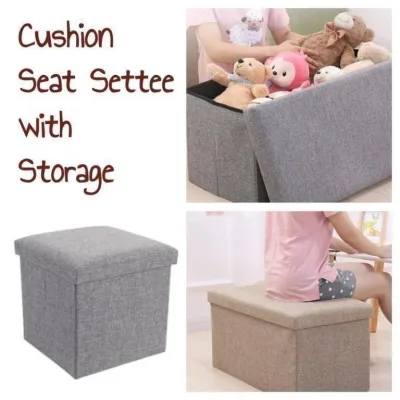
Prices are valid at publication and may change. Please refer to the product page for the latest price.
Crucial Measurements to Check Before You Buy
Before committing to a specific design, accurate measurements are vital to ensure your new furniture fits both your room and your lifestyle. Start by mapping out the physical footprint of the settee on your floor using masking tape. This visual aid allows you to assess whether there is sufficient clearance for daily movement. Ensure there is at least 60 to 75 centimeters of walking space between the settee and other furniture, such as coffee tables or TV consoles. Additionally, verify that nearby cabinet doors, room entryways, and main doors can swing open fully without colliding with the settee.

Beyond the room’s layout, you must carefully evaluate the delivery path from the ground floor to your apartment. Many homeowners overlook the physical constraints of HDB passenger lifts, narrow common corridors, and tight stairwell turns. Measure the height, width, and diagonal clearance of your apartment’s entry door frame, as well as the lift door opening. If your chosen settee is delivered fully assembled, these dimensions will dictate whether the delivery team can safely transport the item into your home without causing damage to the walls or the furniture itself.
Finally, pay close attention to the vertical and depth dimensions of the settee. A piece that is too deep can quickly overwhelm a narrow living room, making the space feel cramped and restricted. If you plan to position the settee beneath a window, measure the height of the windowsill to ensure the backrest does not block natural light. Likewise, check that the height of the settee does not obstruct low-hanging air-conditioning units or disrupt the airflow in the room. Keeping these dimensions in mind helps maintain the visual balance of your home while ensuring standard ceiling heights are not visually compromised.
Top Settee with Storage Designs for Small Layouts
Selecting the perfect storage settee requires understanding how different opening mechanisms align with your storage habits and spatial limitations. The ideal design should match the specific items you plan to store, balancing accessibility with the physical layout of your room.
Lift-Top Storage Settees
Lift-top storage settees feature a classic design where the entire seating platform hinges upward to reveal a deep, continuous storage compartment. Because the internal cavity is undivided by drawers or partitions, this style offers the maximum possible volume for storing large, bulky items. It is an exceptional choice for items you only need to access occasionally, allowing you to keep them completely out of sight but easily reachable when needed.
In a typical Singaporean household, this deep cavity is ideal for storing travel gear, such as winter coats and heavy jackets used for overseas holidays, which would otherwise consume valuable wardrobe space. It is also highly effective for keeping spare bedding, bulky duvets, extra pillows, or even large luggage bags protected from dust. By housing these large items inside the settee, you free up primary closet space for daily wear.
However, the lift-top mechanism comes with specific operational trade-offs that you must consider. Because the entire top surface lifts up, you must remove any loose cushions, decorative throws, or items left on the seat before you can access the storage compartment. Additionally, anyone sitting on the bench must stand up for the lid to open. This makes lift-top models less practical for items you need to retrieve daily, and they require sufficient vertical clearance above the seat to open fully without hitting low shelves or wall-mounted decor.
Drawer-Based Settees
Drawer-based storage settees utilize pull-out drawers built directly into the lower base of the furniture frame. This design excels at keeping smaller household items organized and easily accessible without requiring you to clear the seating surface first. Because each drawer operates independently on metal runners or wooden tracks, you can retrieve items quickly with minimal disruption to anyone currently using the seat.
These settees are highly functional in entryways and foyers, where they can serve as dedicated shoe-changing benches. The drawers provide an organized home for daily footwear, umbrellas, shoe horns, and keys, preventing the entryway from becoming cluttered with loose shoes. In the living room, drawer-based models are perfect for organizing remote controls, gaming accessories, magazines, and children’s toys, keeping everyday essentials within arm’s reach but neatly tucked away.
The primary limitation of drawer-based settees is the physical space required directly in front of the unit. To use the drawers comfortably, you must have enough clear floor space to pull them out to their full extension, plus additional room for you to kneel or bend down. If your living room is narrow or your coffee table is positioned close to the settee, opening the drawers may prove difficult. Furthermore, the internal drawer dividers and runner mechanisms slightly reduce the overall storage volume compared to an open lift-top cavity, making them unsuitable for oversized items.
Modular and Convertible Settees
Modular and convertible storage settees offer the ultimate flexibility for dynamic, modern households. These systems consist of individual seating blocks or sectional pieces that can be rearranged, detached, or combined to suit different activities and room shapes. Many of these modular units feature hidden storage compartments beneath individual cushions, allowing you to distribute your storage across several smaller zones rather than one large bench.
This adaptability is incredibly valuable for irregular HDB floor plans, L-shaped living areas, or multi-purpose rooms that serve as both a home office and a guest bedroom. If you frequently host friends and family, you can easily separate the modules to create individual seating arrangements around a coffee table, then push them back together to form a sleek, continuous bench when the guests leave. The flexibility to reconfigure the layout on demand makes modular settees a smart investment for evolving households.
Despite their versatility, modular settees require careful consideration regarding maintenance and wear. The seams and joints between individual modules can easily trap dust, crumbs, and pet hair, requiring more frequent vacuuming and deep cleaning. Additionally, because these pieces are moved and reconfigured regularly, the connecting brackets, hinges, and locking mechanisms are subjected to constant wear and tear. You will need to inspect these moving parts periodically to ensure they remain secure, stable, and safe to sit on.
Choosing Upholstery and Frames for Humid Climates
Singapore’s tropical climate, characterized by high humidity and warm temperatures year-round, places unique demands on furniture materials. Selecting the wrong upholstery or frame construction can lead to premature wear, unpleasant odors, mold growth, and structural failure. To ensure your storage settee remains durable and comfortable, you must carefully evaluate the materials used in its construction.
When selecting upholstery, prioritize breathability and moisture control. Avoid low-quality synthetic leathers, such as cheap polyurethane (PU), which tend to trap heat and sweat, leading to a sticky, uncomfortable seating experience in non-air-conditioned rooms. Over time, high humidity can also cause these synthetic layers to crack and peel. Instead, look for high-performance fabrics, tightly woven linen-cotton blends, or treated polyester weaves that offer superior airflow and moisture-wicking properties.
Given the multi-functional nature of a storage settee, ease of maintenance is another critical factor. Settees located in high-traffic areas like entryways or dining spaces are highly susceptible to spills, dirt, and sweat. To simplify your cleaning routine, check the manufacturer’s care instructions and prioritize models with stain-resistant fabric treatments. Removable, machine-washable covers are highly recommended, as they allow you to easily wash away accumulated dust mites, pet dander, and odors, keeping your seating fresh and hygienic.
The internal frame of the settee is just as important as its outer appearance. High humidity can cause poorly constructed frames to absorb moisture, leading to warping, joint loosening, and mold development. Verify the manufacturer’s structural specifications and look for frames built from kiln-dried hardwoods, such as teak, oak, or rubberwood. The kiln-drying process removes moisture from the wood before manufacturing, significantly reducing the risk of warping or splitting. If you choose a metal-framed settee, ensure the metal is treated with a rust-resistant powder coating to prevent corrosion in our humid air. Remember that a material name alone does not guarantee performance; always check the specific joinery, finish, and care guidelines provided by the manufacturer.
Final Pre-Purchase Checklist and Safety Checks
Before finalizing your purchase and heading to the checkout, conducting a thorough safety and quality check is essential to protect your household and your investment. Because storage settees combine structural furniture with moving mechanical parts, they require closer scrutiny than standard seating options.
First, verify the manufacturer’s stated weight capacity for both the seating surface and the internal storage compartment. A high-quality settee should comfortably support the weight of multiple seated adults without sagging or shifting. Additionally, the storage base must be sturdy enough to hold your stored items without bowing. Never exceed these limits, as overloading the settee can compromise its structural integrity and cause the support joints to fail over time.
Second, pay close attention to the safety features of the opening mechanisms, especially if the settee will be used frequently. For lift-top models, look for heavy-duty pneumatic gas lifts or certified soft-close hinges. These safety stays prevent the heavy lid from slamming shut unexpectedly, protecting fingers from being pinched and reducing wear on the frame. If the settee uses pull-out drawers, ensure they are equipped with safety stops to prevent the drawers from being pulled entirely out of their tracks and falling onto your feet.
Lastly, carefully review the manufacturer’s warranty terms. A reliable warranty should cover not only the wooden or metal frame but also the moving parts, hinges, and gas lifts, which are the components most prone to wear over time. Understand what is excluded from the warranty, such as fabric wear or damage caused by improper assembly, and keep your proof of purchase secure. Taking these final verification steps ensures your new storage settee remains a safe, functional, and durable addition to your home for years to come.
Frequently Asked Questions (FAQ)
How much weight can a typical storage settee hold?
The weight capacity of a storage settee varies significantly depending on its frame construction, dimensions, and the quality of its support joints. Generally, a well-constructed two-seater wooden settee can support a static seating weight of 150 to 200 kilograms, while the internal storage compartment may hold between 20 to 50 kilograms. However, these figures are general guidelines and should not be assumed for every model. To ensure safety and prevent structural damage, always refer to the manufacturer’s official specification sheet for the exact weight limits of your chosen product before purchasing.
Are lift-top settees safe for homes with young children?
Lift-top settees can pose safety hazards for young children due to the weight of the lid and the potential for fingers to get pinched in the hinges. To minimize these risks, look for models equipped with high-quality pneumatic safety stays or soft-close hinges that slow down the descent of the lid and hold it open automatically at various angles. It is highly recommended to supervise young children when they are near the settee and to teach them not to play inside or around the storage compartment. For homes with very active toddlers, drawer-based or open-shelf storage benches are often a safer alternative.
Community discussion
Share your experience or ask a question. Comments are reviewed before publication.