
A sticking, squeaking, or jumping bathroom sliding door is often the result of worn-out rollers. To restore smooth and quiet operation, finding an exact replacement is critical because even a single millimeter of variance can cause the door to bind, derail, or fail to fit the track entirely. Before purchasing a new bathroom sliding door roller, you must verify several physical dimensions, mounting configurations, and material compatibilities.
Identify the Mounting Style and Attachment Method
First, determine whether your bathroom door uses a top-hung or a bottom-rolling system. Top-hung doors suspend the weight from an upper track, meaning the rollers are mounted to the top edge of the door frame. Bottom-rolling systems support the weight from below, with the rollers nestled inside the bottom rail of the door.
Next, examine how the roller assembly attaches to the door. Common designs include screw-in brackets, clip-on mechanisms, spring-loaded tension rollers, and permanently riveted assemblies. If your roller is riveted to the bracket, you will likely need to replace the entire bracket assembly rather than just the wheel.
Products mentioned in this guide
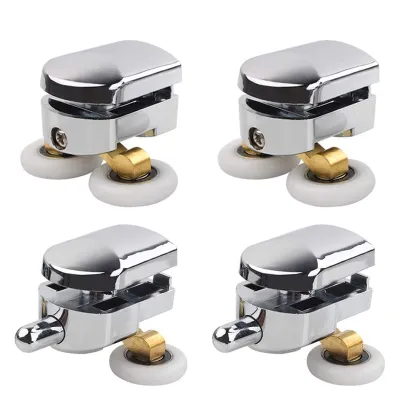
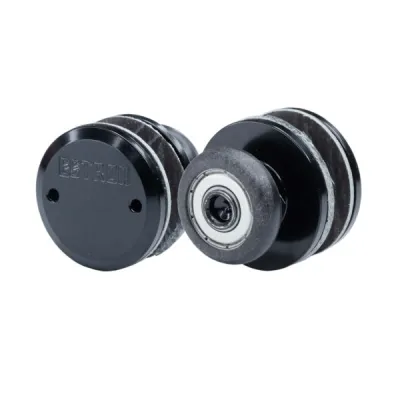
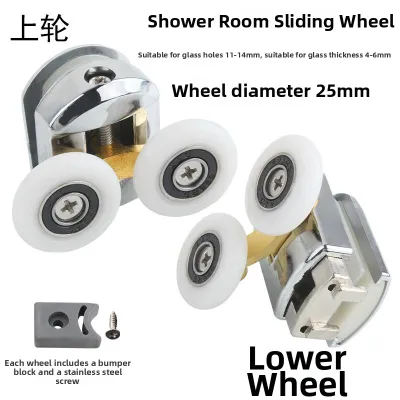
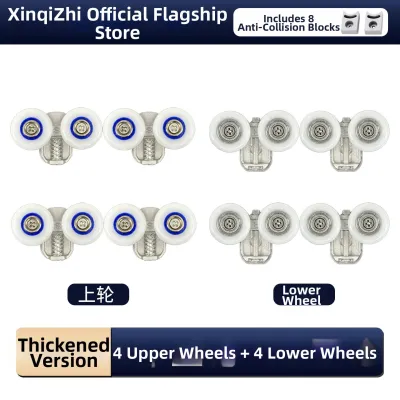
![UnihomSG [One SET] Strong Toilet Bifold Door Roller Top & Bottom Replacement for Bi Fold Toilet Door Kitchen or Washroom](https://img.lazcdn.com/g/p/34ec9c54ba793d7400f9ac58b5e5a368.png_400x400q80.png_.webp)

Prices are valid at publication and may change. Please refer to the product page for the latest price.
Pay close attention to the orientation of the mounting bracket. Measure the exact center-to-center distance between any screw holes. This spacing must match your replacement part perfectly to avoid the need to drill new holes in a delicate aluminum frame or glass clamp.
Measure the Critical Roller Dimensions
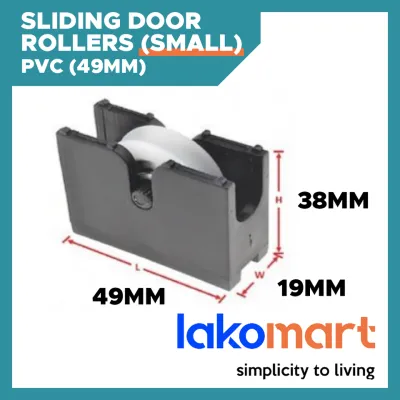
When it comes to hardware replacements, precision is vital. Standard tape measures often lack the resolution needed for tiny hardware components, making it easy to misread a dimension by a crucial millimeter. Using a digital caliper is highly recommended to get an accurate reading of the wheel and axle.

Before taking measurements, inspect the old roller for signs of wear. Over time, constant friction can create flat spots, reduce the overall wheel diameter, or deform the outer edge. If the wheel is heavily worn, measure a less damaged roller from the same door if possible, or round up slightly to the nearest standard hardware size.
Wheel Diameter and Thickness
Measure the outer diameter of the wheel from edge to edge. This dimension must clear the internal height of your sliding track; a wheel that is too large will rub against the top of the track channel, while a wheel that is too small may cause the door to sag or wobble.
Next, measure the thickness of the wheel at its widest point. The wheel must slide freely within the track channel without binding against the side walls. Ensure there is a small amount of clearance on either side to accommodate minor track misalignments.
Axle Width and Length
The axle is the central pin or bolt around which the wheel rotates. Measure the outer diameter of the axle or the mounting screw that passes through the door bracket. If the replacement axle is too thick, it will not fit through the bracket hole; if it is too thin, the wheel will wobble and wear out prematurely.
Additionally, check the overall length of the axle. It must be long enough to span the thickness of the mounting bracket and leave sufficient thread or clearance for securing hardware, such as a locking nut, retaining clip, or snap ring.
Evaluate Wheel Material and Track Compatibility
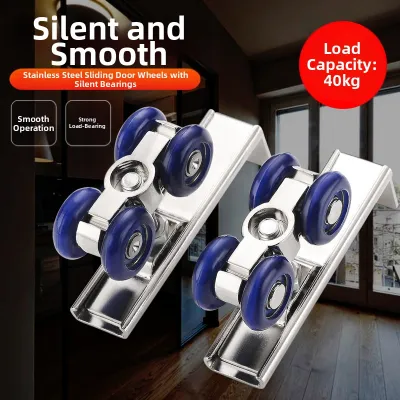
Bathroom environments are highly humid, making material selection a key factor in how long your replacement rollers will last. Common wheel materials include nylon, polyoxymethylene (POM), and stainless steel. Nylon and POM wheels offer quiet operation and smooth gliding, but you should check their wear ratings for heavy glass doors. Stainless steel rollers offer excellent rust resistance and high load capacity, but they can be noisier during operation.
You must also match the wheel profile to the shape of your track. Examine whether your track requires a V-groove wheel (which rides on a pointed ridge), a U-groove wheel (which hugs a rounded rail), or a flat wheel (which rolls along a flat surface). Using the wrong profile will cause the door to derail or slide unevenly.
Be cautious when pairing materials. Avoid installing hard stainless steel wheels on soft aluminum tracks. The harder metal can quickly wear grooves into the aluminum, permanently damaging the track and requiring a costly full-track replacement.
Verify Weight Capacity and Door Thickness Limits
Before finalizing your purchase, check the manufacturer’s load rating for the replacement rollers. Calculate the total weight capacity needed by estimating the weight of your door and dividing it by the number of rollers (typically two per door). Ensure the rollers are rated to support this load comfortably.
Verify the maximum door thickness that the roller bracket can accommodate. This is especially important for frameless glass sliding doors, where the roller clamp must grip the glass securely without slipping or putting uneven pressure on the pane.
Consider the door material itself. Heavy tempered glass, thick aluminum frames, and solid wood doors distribute weight differently. Ensure the mounting brackets are designed specifically for your door type to prevent stress points that could crack glass or warp thin metal frames.
Your Pre-Purchase Measurement Checklist
To simplify your search at a local hardware store or on an online marketplace, compile your measurements into a structured checklist. Record the following details before you start shopping:
- Mounting System: Top-hung / Bottom-rolling
- Attachment Type: Screw-in / Clip-on / Spring-loaded
- Screw Hole Spacing: _____ mm
- Wheel Outer Diameter: _____ mm
- Wheel Thickness: _____ mm
- Axle Diameter: _____ mm
- Axle Length: _____ mm
- Wheel Profile: V-groove / U-groove / Flat
- Wheel Material: Nylon / POM / Stainless Steel
Before removing the old hardware, take clear, well-lit photos of the roller assembly from multiple angles, including the bracket attachment and the track profile. These photos are invaluable for visual matching when comparing options online.
Finally, check the retailer’s return policy. Specialized hardware can be tricky to match on the first try, so choosing a seller that allows easy returns or exchanges for incorrect sizes will save you time and money.
Frequently Asked Questions (FAQ)
Can I upgrade from plastic to stainless steel rollers?
You can upgrade to stainless steel rollers if your track is made of a compatible hard material, such as stainless steel or heavy-duty brass. However, if you have a soft aluminum track, stick to nylon or POM wheels to prevent the metal from grinding down the track. Regardless of the material you choose, the replacement wheel must match the exact profile and dimensions of the original.
Do I need to replace the track when changing the rollers?
You do not need to replace the track if it is straight, smooth, and free of physical damage. Inspect the track for deep gouges, bends, or severe corrosion that could obstruct the new rollers. If the track is in good condition, a thorough cleaning to remove soap scum and hair, followed by a light application of silicone lubricant, is usually sufficient to restore smooth operation.
Community discussion
Share your experience or ask a question. Comments are reviewed before publication.