
A standard bamboo shoe rack bench typically holds between 4 and 12 pairs of adult shoes, depending on the bench’s width and the number of tiers. To find your ideal capacity, balance your immediate daily-wear storage needs with your entryway’s spatial constraints.
In Singapore homes, such as HDB flats or condominiums, the entryway is a high-traffic transition zone where space is at a premium. A bamboo shoe rack bench serves a dual purpose: a convenient seat for putting on footwear and a neat storage solution for your most frequently used pairs. Choosing the right capacity prevents your foyer from becoming cluttered while ensuring you have a stable, comfortable place to sit.
Assessing Your Household's Shoe Storage Needs
Determining the right capacity for your bamboo shoe rack bench begins with a realistic assessment of your household’s daily footwear habits. A common mistake is trying to fit an entire shoe collection onto a single entryway bench. Instead, focus on the shoes your household members wear on a daily basis, such as school shoes, work heels, daily sneakers, and casual sandals.
Products mentioned in this guide
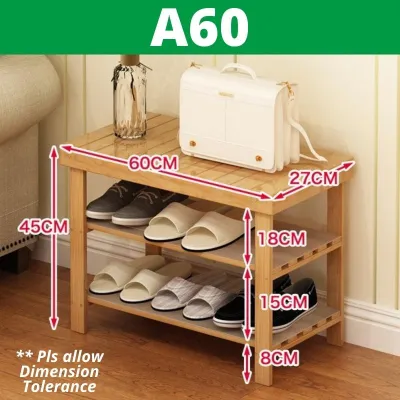
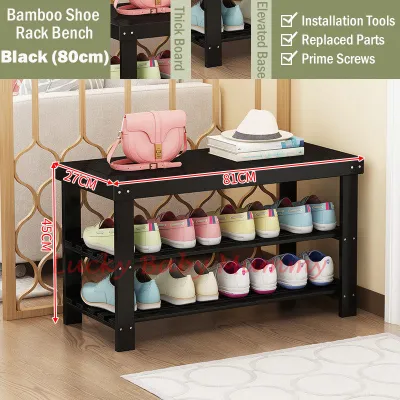
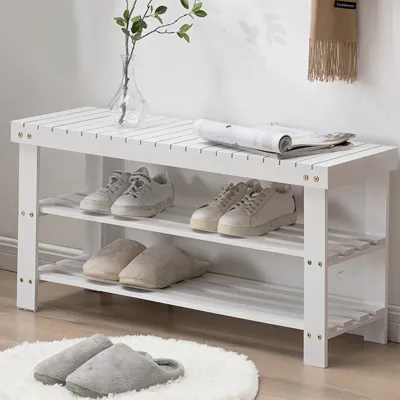
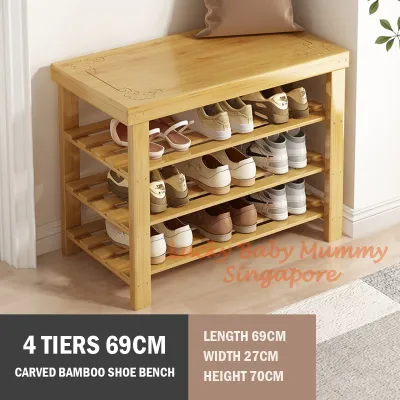
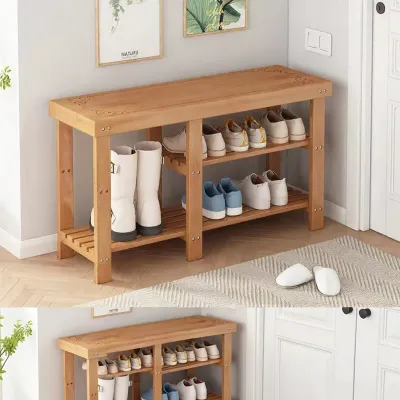
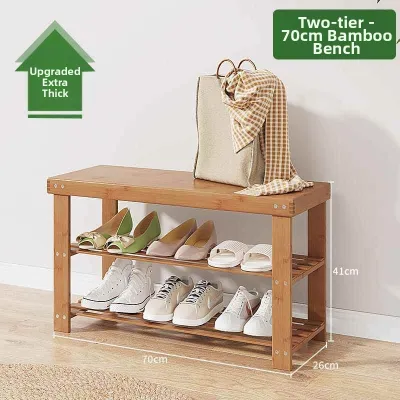
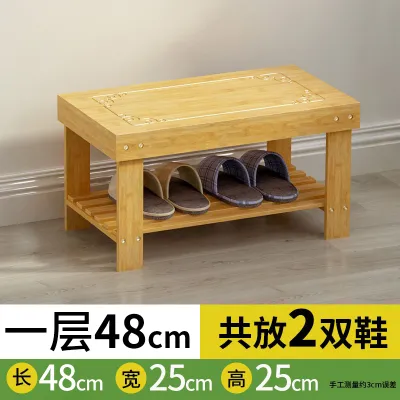
Prices are valid at publication and may change. Please refer to the product page for the latest price.
To calculate your actual storage requirements, multiply the number of household members by the number of active pairs they use throughout the week. For a household of three, if each person has one pair of work or school shoes, one pair of running shoes, and one pair of casual slides, you will need space for at least nine pairs of shoes. This simple calculation gives you a baseline capacity before you begin looking at specific furniture dimensions.
It is also important to remember that a “pair of shoes” is not a standard unit of measurement. The physical space a pair occupies varies dramatically depending on the footwear type. For example, bulky running trainers, high-top basketball shoes, or platform heels take up significantly more physical volume than flat leather sandals, slip-ons, or flip-flops. If your household mostly wears chunky sneakers, a bench rated for eight pairs might only comfortably hold six.
To optimize your entryway, differentiate between active storage and long-term storage. The entryway bench should be reserved exclusively for high-rotation footwear. Occasional shoes, such as formal dress shoes, seasonal boots, or specialized sports gear, are better suited for long-term storage in bedroom wardrobes, closed shoe cabinets, or dedicated storerooms. Keeping these out of the entryway preserves valuable bench space.
Before purchasing a new bench, conduct a thorough audit of your current footwear collection. Gather all the shoes currently lying around your entryway and sort through them. Discard worn-out pairs, donate those that no longer fit, and clean the remaining items. Establishing this realistic, decluttered baseline ensures you do not buy an oversized bench that unnecessarily crowds your foyer.
Translating Bamboo Bench Dimensions into Real Capacity
Once you know how many pairs of shoes you need to store, you can translate those needs into physical furniture dimensions. The width of a bamboo shoe rack bench is the primary factor determining how many pairs can fit side-by-side on a single tier. Understanding standard bench widths helps you match your shoe count to the right model.

For compact entryways, a bench width of 60 cm to 70 cm (often classified as a compact two-seater) typically accommodates two to three pairs of standard adult shoes per tier. If you opt for a wider model of 80 cm to 90 cm, you can comfortably fit three to four pairs per tier. Large benches measuring 100 cm or more can hold four to five pairs of adult shoes per tier, making them ideal for larger families.
When evaluating capacity, you must also choose between two-tier and three-tier configurations. This choice involves a direct trade-off between comfortable seating height and maximum storage volume. A two-tier bench typically maintains a standard seating height of 40 cm to 45 cm, which is ergonomically ideal for most adults. A three-tier bench increases your storage capacity by 50 percent, but it may either raise the seating surface to an uncomfortable height or compress the vertical clearance between the shelves.
Vertical clearance is a critical factor that is easily overlooked. Fixed shelves are common in bamboo furniture, meaning you cannot adjust the height between tiers. Standard sneakers and flats require a vertical clearance of at least 15 cm to slide in and out easily. If you own high-tops, mid-cut boots, or high heels, you will need a clearance of 20 cm or more. Always check the manufacturer’s internal shelf dimensions to ensure your specific footwear types will fit without being bent or squished.
While bamboo is celebrated for its excellent strength-to-weight ratio, it is not indestructible. You must verify the manufacturer’s stated weight capacity for both the seating surface and the individual shelves rather than assuming the material can support unlimited weight. Look closely at the joinery quality; high-quality benches utilize recessed metal screws and sturdy cross-bracing. Avoid models that rely solely on simple glued joints, as they are prone to sagging, wobbling, or joint failure under heavy loads.
Measuring Your Entryway for Space and Clearance
Even the most practical shoe bench is a poor choice if it blocks your entryway or restricts movement. Carefully measuring your foyer, corridor, or landing ensures your chosen bamboo bench fits safely and functions well within your home’s layout.
Begin by measuring the exact width, depth, and height of the available wall space where you plan to place the bench. When measuring, do not just measure the open floor; remember to account for skirting boards or baseboards, which can push the bench forward by 1 cm to 2 cm. Additionally, check for nearby electrical outlets, light switches, or utility distribution board (DB) box doors that must remain completely unobstructed and accessible.
Next, consider the clearance required for daily movement. Ensure the bench does not block the swing path of your main door, security gate, or adjacent closet doors. You should also leave at least 60 cm of clear walkway space in front of the bench when someone is seated. If your entryway is a narrow corridor, a bench that is too deep will restrict foot traffic, making it difficult to carry groceries or move large household items past the foyer.
Safety and compliance are particularly important for residents in Singapore. If you live in an HDB flat or a condominium and plan to place your bamboo shoe bench outside your main door in a shared common corridor, you must adhere to local fire safety guidelines. The Singapore Civil Defence Force (SCDF) mandates that a minimum clear escape passage of 1.2 meters must be maintained along common corridors. Placing furniture that violates these rules can result in fines or requests for removal, so always verify these clearances before purchasing.
To visualize the spatial impact of the bench before buying, use painter’s tape to map out the bench’s exact footprint on your entryway floor. Leave the tape in place for a day or two. Walk around the area, open and close your doors, and practice sitting down to ensure the physical presence of the bench will not create a tripping hazard or make the space feel cramped.
Common Capacity and Sizing Mistakes to Avoid
To prevent buyer’s remorse, steer clear of several common pitfalls that shoppers encounter when selecting a bamboo shoe rack bench. Being aware of these issues helps you choose a model that remains functional for years to come.
One frequent mistake is overlooking vertical space. Many buyers focus entirely on the length of the bench, forgetting that tall boots or chunky sneakers require more vertical clearance between the bamboo shelves. If the clearance is too tight, you will be forced to store these shoes sideways, which reduces the usable tier capacity and can damage the shape of your footwear.
Another error is ignoring future household growth. A shoe collection is rarely static; children grow, hobbies change, and new household members may join. Buying a bench that is already at 100 percent capacity on day one leaves no room for natural expansion, which quickly leads to shoes overflowing onto the floor and creating visual clutter.
Compromising the stability of the bench is also a significant risk. Overloading a lightweight or poorly reinforced bamboo frame beyond its intended structural limits can lead to tipping or joint failure. When multiple people use the bench daily, a weak frame will degrade quickly. Always prioritize a robust design with a stable base over a flimsy, high-capacity model.
Finally, avoid prioritizing seating comfort over practical storage space. While a thick, plush cushion on top of the bench looks inviting, it often eats into the vertical space available for the shelves underneath. If the overall height of the bench must remain low for comfortable seating, a thicker cushion means shorter shelf clearances. Look for a balanced design where the cushion or wooden seat does not severely restrict the usability of the storage tiers below.
Frequently Asked Questions (FAQ)
What is the ideal depth for a bamboo shoe rack bench?
The ideal external depth for a bamboo shoe rack bench is typically between 30 cm and 35 cm. This depth allows standard adult shoes, up to a US size 12, to sit flat on the shelves without hanging over the edge or blocking the walkway. Always verify the interior shelf depth in the product specifications, as external dimensions often include the frame’s thickness.
Can a bamboo shoe bench support the weight of someone sitting on it?
Yes, most high-quality bamboo shoe benches are designed to support an adult’s weight, but capacities vary based on construction quality. Standard models typically support between 100 kg and 150 kg on the seating surface. Always check the manufacturer’s explicit weight rating and ensure all hardware is tightened securely during assembly to maintain structural integrity.
Community discussion
Share your experience or ask a question. Comments are reviewed before publication.