
Selecting a three-seater recliner sofa is a major lifestyle and financial commitment. Unlike standard stationary sofas, a motion sofa integrates complex mechanical linkages, electrical systems, and high-stress joints that must withstand daily movement. Finding the right balance between comfort and build quality requires looking beyond aesthetic appeal and initial showroom softness. The ideal choice depends heavily on how you plan to use the sofa, your physical ergonomic needs, and your willingness to invest in structural longevity.
While premium specialist brands focus on engineered mechanical durability and targeted orthopedic support, mass-market retailers offer versatile styles with accessible local warranties. On the other hand, online-first, value-driven brands cater to budget-conscious buyers or temporary living arrangements. For a larger three-seater configuration, evaluating the internal frame materials, suspension systems, and delivery access is far more critical than relying on a brand name alone.
Core Metrics to Evaluate Comfort and Build Quality
To make an informed decision, you must look past marketing buzzwords and evaluate the physical components that dictate how a recliner performs over time. Comfort and build quality are highly technical attributes that can be verified through observable structural details.
Products mentioned in this guide
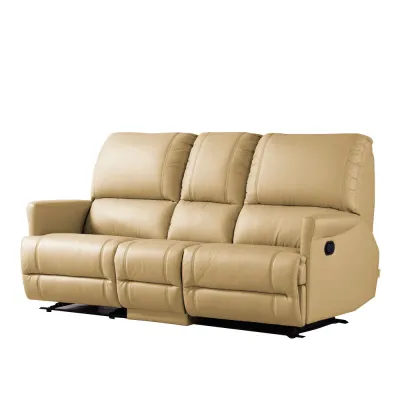
![[Free Installation] Univonna Javier 3-Seater Recliner Sofa | Modern PU Leather Sofa | Comfortable Manual Recline | Custom Colors & Free Delivery](https://img.lazcdn.com/g/p/efc6050842ae33687b515884fae613f5.jpg_400x400q80.jpg_.webp)
Prices are valid at publication and may change. Please refer to the product page for the latest price.
Comfort Assessment
True seating comfort is determined by foam density, suspension design, and ergonomic dimensions rather than initial plushness. Showroom sofas often feel incredibly soft because they use low-density polyurethane foam or heavy polyester fiberfill, which can flatten within twelve to eighteen months of daily use. For lasting support, look for high-density polyurethane foam with a rating of at least 30 kg/m³ to 35 kg/m³ in the seat cushions.
An excellent comfort test is to check how quickly the cushion bounces back after you stand up; high-resiliency (HR) foam recovers its shape instantly, indicating it will maintain its supportive properties for years. Additionally, evaluate the lumbar support by sitting in the upright position without reclining. Your lower back should feel firmly supported without leaving a hollow gap between your spine and the backrest. Seat depth is equally critical; standard seat depths range from 50cm to 56cm, and your feet should rest flat on the floor when the chair is not reclined to prevent pressure buildup behind your knees.
Build Quality Verification
The internal frame is the most critical element of a recliner’s build quality. Avoid frames constructed from standard particleboard or thin plywood held together by staples, as these materials warp and split under the shifting weight of a reclining mechanism. Insist on frames made from kiln-dried hardwood, such as birch, oak, or rubberwood. The kiln-drying process is vital in Singapore’s humid climate, as it extracts moisture from the wood to prevent warping, rot, and joint loosening over time.
When testing a sofa, operate the reclining mechanism multiple times to assess its quality. The movement should be fluid, quiet, and consistent, without any grinding, clicking, or lateral wobbling. Inspect the upholstery seam strength along high-tension areas, such as the footrest and headrest joints. Double-stitched seams using heavy-duty nylon thread are essential to prevent fraying. Remember that material terms like “genuine leather” or “linen” do not guarantee durability; always check the manufacturer’s care instructions and ask for the Martindale rub count, aiming for at least 20,000 double rubs for daily family use.
Space and Access Checks
Three-seater recliners require significantly more physical space than standard sofas, making precise measurements essential before purchasing. Standard recliners need a clearance of 30cm to 50cm behind the backrest to fully recline. If your living room is compact, look for “wall-hugger” or “zero-wall” designs that slide forward on their tracks as they recline, requiring only 10cm to 15cm of rear clearance. Always measure the fully extended footprint of the sofa, which can stretch up to 180cm from the backrest to the tip of the footrest, to ensure it does not block walkways.
For Singapore apartments, physical delivery access is a frequent bottleneck. Standard HDB passenger lifts and condominium service lifts often have strict height and depth limitations. Many three-seater recliners are incredibly heavy and bulky, but high-quality brands design them with modular, detachable backrests. Always ask the retailer for the exact packaged dimensions of the delivery boxes and verify whether the delivery team can disassemble and reassemble the units on-site to navigate tight corridors, lift doors, and household entryways.
Comparing Brand Tiers in the Singapore Market
Understanding how different brand tiers approach manufacturing helps you align your budget with your expectations for comfort and durability.

Specialist Recliner and Heritage Brands
Specialist brands focus almost exclusively on motion furniture, investing heavily in proprietary mechanical engineering and ergonomic research. These manufacturers typically use solid steel chassis or premium laminated birch frames that can support heavy weight loads for decades. Instead of standard cut foam, they often utilize molded cold-cured polyurethane foam, which is poured into a mold around the steel frame to ensure uniform density, exceptional pressure distribution, and lifetime shape retention.
Comfort in this premium tier is highly customizable, featuring independent adjustments for the headrest, lumbar support, and footrest. The mechanical linkages operate with absolute precision, utilizing self-lubricating bushings that eliminate squeaks and friction. This tier is the best investment for a primary living room sofa that will see heavy, daily use by multiple family members, particularly if orthopedic support and joint relief are high priorities. Expect to pay premium prices, typically ranging from S$3,000 to over S$8,000 for high-grade leather three-seater configurations.
Mass-Market Furniture Retailers
Mass-market furniture retailers offer a diverse selection of living room furniture, allowing you to coordinate your three-seater recliner with matching coffee tables, sideboards, and armchairs. These brands prioritize versatile aesthetic designs, offering a wide array of fabric textures, colors, and modular configurations. While their recliners provide highly satisfactory comfort for the average user, the internal reclining mechanisms are generally sourced from external OEM suppliers rather than engineered in-house.
Frame construction in this tier typically combines solid wood with furniture-grade plywood, offering reliable stability for standard residential use. The primary advantage of mass-market retailers is accessibility; they maintain spacious physical showrooms across Singapore where you can test different models in person. They also offer straightforward local customer service, reasonable delivery timelines, and accessible warranties. This tier represents a balanced middle ground, with prices for a three-seater recliner generally ranging from S$1,200 to S$3,000.
Value-Driven and Online-First Brands
Value-driven and online-first brands cater to budget-conscious shoppers and those living in temporary accommodations. These brands excel at modern, space-saving designs that fit perfectly into smaller apartments. To keep retail prices highly competitive, they often utilize lighter-gauge steel for their mechanisms and lower-density polyurethane foam topped with thick polyester fiberfill. This combination creates an initial feeling of plush, cloud-like softness in the showroom or upon delivery.
However, this initial comfort can degrade within a few years of heavy use as the foam compresses and the mechanical linkages develop slight alignment issues. The weight capacity per seat is also typically lower, often capped around 90kg to 100kg compared to the 130kg+ capacities of premium brands. This tier is highly suitable for secondary seating areas, guest rooms, rental properties, or buyers who plan to upgrade their living room layout within three to five years. Prices are highly accessible, frequently falling under S$1,000.
Long-Term Value: Durability and Warranty Verification
To understand the true cost of ownership, you must evaluate how well a recliner is protected against mechanical failure and how easily it can be serviced over time.
Warranty Breakdown
Never rely solely on a generic “10-year warranty” marketing claim. You must read the warranty document to understand how coverage is partitioned across different components of the sofa. A typical recliner warranty is split into three distinct tiers:
- The Frame: Often covered for 5 to 10 years against structural cracking or warping.
- The Reclining Mechanism and Motor: Typically covered for 1 to 5 years. This is the most critical warranty window for a motion sofa, as a broken motor or bent steel linkage can render the entire seating bay unusable.
- The Upholstery and Cushioning: Usually limited to 1 to 2 years, covering manufacturing defects like split seams or premature leather peeling, but excluding normal wear and tear or foam softening.
Prioritize brands that offer at least a three-year warranty on the electrical motors and mechanical moving parts, as these are the components subjected to the most physical stress.
Motorized vs. Manual Mechanisms
Choosing between a motorized (power) recliner and a manual pull-lever system involves clear trade-offs in terms of user experience and mechanical longevity. Manual recliners rely on physical tension, springs, and a release lever. They have fewer moving parts, require no electrical power, and can be placed anywhere in a room without worrying about cable safety or proximity to wall sockets. However, they offer limited locking angles—usually only upright, semi-reclined, and fully reclined—and closing the footrest requires physical leg strength, which can be challenging for elderly users or those with knee joint pain.
Power recliners use electric motors to provide smooth, effortless, and infinite adjustments, allowing you to stop the recline at the exact angle that suits your body. Many models also include integrated USB charging ports and independent headrest controls. The primary drawback is their reliance on electrical components. Power surges, motor burnout, or damaged internal wiring can disable the reclining function. If you choose a power model, protect the electronics by plugging the power supply into a high-quality surge protector and ensure the brand uses certified, low-voltage motors.
After-Sales Service
A three-seater recliner is an exceptionally heavy piece of furniture, often weighing between 80kg and 120kg. If a motor fails or a mechanical joint begins to squeak, transporting the entire sofa back to a warehouse for repair is logistically difficult and expensive. When shopping in Singapore, prioritize brands that employ their own in-house team of local technicians who can perform on-site, in-home repairs.
Ask the retailer directly about their service policy: Do they charge a transport fee for diagnostic visits? Do they stock replacement motors, transformers, and hand controls locally in Singapore? Brands that maintain a local inventory of spare parts can resolve mechanical issues within days, whereas brands without local support may leave you with a non-functioning recliner for weeks while they wait for replacement parts to ship internationally.
Decision Framework: Which Brand Tier Should You Choose?
To finalize your decision, align your specific household requirements, physical space, and budget with the strengths of each brand tier.
- Choose Specialist Brands if: You require highly precise, ergonomic lumbar and neck support for daily, extended sitting; you view the sofa as a ten-to-fifteen-year investment; and your budget comfortably accommodates premium pricing (S$3,000+).
- Choose Mass-Market Retailers if: You want a recliner that coordinates seamlessly with your existing living room decor, prefer testing different models in a local showroom, value straightforward local warranty support, and have a mid-range budget of S$1,200 to S$3,000.
- Choose Value-Driven Brands if: You are furnishing a secondary living space, guest room, or rental property; you have a strict budget under S$1,000; or you anticipate moving or changing your furniture layout within the next three to five years.
- Verify First if: You are purchasing online without testing. Always confirm the return policy for comfort dissatisfaction, check the maximum weight capacity per seat, and verify the packaged dimensions to ensure the sofa can safely navigate your home's entryways and lift.
Frequently Asked Questions (FAQ)
Do 3-seater recliners require more maintenance than single-seaters?
Yes, three-seater recliners require more consistent maintenance because they house multiple independent reclining mechanisms and electrical components within a single frame. To prevent uneven wear on the frame and suspension, try to distribute seating usage evenly across all three seats rather than always sitting in the same spot. Periodically vacuum the gaps between the seats and the underside of the sofa to remove dust, pet hair, and small debris that can accumulate in the moving metal linkages and cause friction or motor strain. If the mechanical joints begin to squeak, check the manufacturer’s guidelines to see if they recommend applying a small amount of silicone-based lubricant to the metal pivot points.
Is it better to buy a manual or power recliner for long-term durability?
From a purely mechanical standpoint, manual recliners generally offer greater long-term durability because their simple lever-and-spring systems have fewer potential failure points and contain no electronic parts. However, power recliners subject the frame and mechanism to much less physical shock, as the electric motors open and close the sofa with a smooth, controlled motion, whereas manual systems often snap open and closed with significant force. If you prioritize mechanical simplicity and independence from electrical outlets, a manual model is ideal. If you prefer infinite adjustability and gentle, controlled movement, a power recliner is the superior choice, provided you protect it with a surge protector and select a brand with a strong local warranty on electrical components.
Community discussion
Share your experience or ask a question. Comments are reviewed before publication.